Operations | Monitoring | ITSM | DevOps | Cloud

The latest News and Information on Containers, Kubernetes, Docker and related technologies.

Attack of the mutant tags!Or why tag mutability is a real security threat

Tag mutability can introduce multiple functional and security issues. In container land, tags are a volatile reference to a concrete image version in a specific point in time. Tags can change unexpectedly, and at any moment. In this article, we’ll learn how we can prevent them.

Simplify Installation and Maintenance with the Project Calico Operator

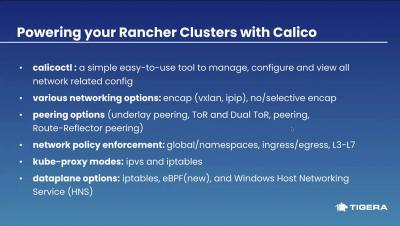
Within the Kubernetes ecosystem, the Operator Pattern aims to encode the tasks that human operators perform with installing, maintaining, and upgrading infrastructure. It goes beyond manifests and Helm charts to add additional logic to manage critical services. Starting with the 3.15 release, Project Calico will provide an operator for managing Calico installations on Kubernetes clusters.

Kubernetes observability tutorial: Log monitoring and analysis

Kubernetes has emerged the de facto container orchestration technology, and an integral technology in the cloud native movement. Cloud native brings speed, elasticity, and agility to software development, but also increases the complexity — with hundreds of microservices on thousands (or millions) of containers, running in ephemeral and disposable pods. Monitoring such a complex, distributed, transient system is challenging, and at the same time very critical.

Upgrade Your K3s Clusters Smoothly in Rancher 2.4

In Rancher 2.4, the latest release of Rancher Labs’ open source Kubernetes management platform, you can now manage K3s cluster upgrades from the Rancher UI. K3s is a lightweight Kubernetes distribution from Rancher that you can use to set up your development Kubernetes environment within minutes. It is great for production use cases and is built primarily for IOT and Edge devices. In Rancher 2.4, you can import K3s clusters and can manage the upgrades for it via Rancher itself.

Cloud-native benchmarking with Kubestone

Organizations are increasingly looking to containers and distributed applications to provide the agility and scalability needed to satisfy their clients. While doing so, modern enterprises also need the ability to benchmark their application and be aware of certain metrics in relation to their infrastructure. In this post, I am introducing you to a cloud-native bench-marking tool known as Kubestone.

Designing an Opensource Observability Stack for Distributed Environments - Tech Strong Conf.

Observability teams today are facing increasing challenges in achieving visibility into the systems they monitor. Kubernetes adds significant complexity to achieving this goal. Open source provides powerful options and comes with serious advantages in cost, agility, and speed. Join Logz.io co-founder Asaf Yigal to learn how you can gain observability into Kubernetes projects with open source tools.

Peaking into your container and infrastructure

Containers get shipped by the thousand, but how do you keep track of the health and status of all those individual compute units? You can do it following the principles behind observability, you can see what’s happening with the infrastructure and the applications using open source tools. In this talk, we’ll describe how easy it is to implement the OSS tools required to get full observability and how that’ll improve your operations and your development cycles.

Deploying a Containerized App in Google GKE

Because of its popularity and widespread adoption, Kubernetes has become the industry’s de facto for deploying a containerized app. Google Kubernetes Engine (GKE) is Google Cloud Products’ (GCP) managed Kubernetes service. It provides out-of-the-box features such as auto-scaling nodes, high-availability clusters, and automatic upgrades of masters and nodes. In addition, it offers the most convenient cluster setup workflow and the best overall developer experience.

On-Demand Webinar: Extending Your Fortigate Next-Gen Firewall to Kubernetes

Companies are leveraging the power of Kubernetes to accelerate the delivery of resilient and scalable applications to meet the pace of business. These applications are highly dynamic, making it operationally challenging to securely connect to databases or other resources protected behind firewalls. Tigera and Fortinet have joined forces to solve this operational challenge. With the combination of FortiGate Next-Gen firewalls and Calico Enterprise, you gain full visibility into the container environment and can define fine-grained policies to determine which Kubernetes workloads are allowed to talk to the enterprise’s crown jewels running outside the Kubernetes cluster.