Operations | Monitoring | ITSM | DevOps | Cloud

The latest News and Information on Cloud monitoring, security and related technologies.

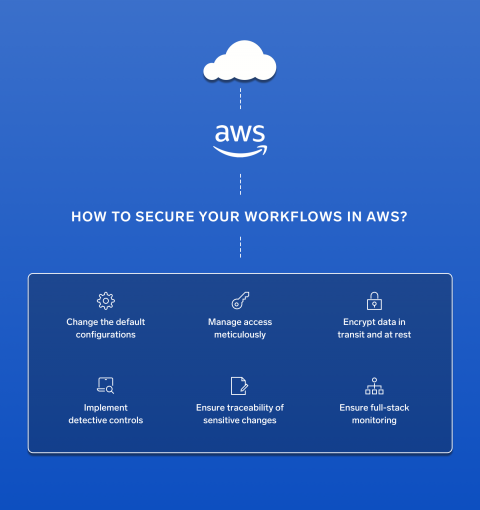
6 steps to secure your workflows in AWS

On AWS, your workloads will be as secure as you make them. The Shared Responsibility Model in which AWS operates ensures the security of the cloud, but what’s in the cloud needs to be secured by the user. This means that as a DevSecOps professional, you need to be proactive about securing your workloads in the Amazon cloud. Achieving the optimal level of security in a multi-cloud environment requires centralized, automated solutions.

How I made AWS Lambda work for my SaaS

A big part of Checkly runs on AWS Lambda, but I never really discussed it in depth before on this blog. So here we go. Topics are: Note, I'm using "Lambda" here as a stand in for "serverless" in general. Many of the things discussed here apply to either Google Cloud Functions, Azure Functions and possibly Zeit although I've never used it. First something on how we use Lambda. Last week we went over 35 million check runs.

AWS Lambda with Node.js: A Complete Getting Started Guide

AWS Lambda is a service that confuses many people. For that reason, you may be wondering just how it works, and how you’d use it to build a highly scalable event-driven application. As someone who’s presumably no stranger to the internet, you must have seen the terms serverless, function-as-a-service, or AWS Lambda thrown across your screen a few times. Perhaps you’re looking to learn more. If so, you’re in luck.

Serverless Web Apps with AWS and Kotlin

This post takes a look at Kotlin, a relatively new programming language that runs on the JVM, and explores how it can be used to build serverless web apps on AWS using Lambda and API Gateway. In programming language terms Kotlin is a relative newcomer. It was first announced in 2011 by JetBrains, the makers of IntelliJ IDEA, and was designed as a modern successor to Java.

How to monitor Lambda with CloudWatch Metrics

With AWS Lambda, you have basic observability built into the platform with CloudWatch. CloudWatch offers support for both metrics and logging. CloudWatch Metrics gives you basic metrics, visualization and alerting while CloudWatch Logs captures everything that is written to stdout and stderr. In this post, we will take a deep dive into CloudWatch Metrics to see how you can use it to monitor your Lambda functions and its limitations.

Ultimate Serverless Benchmark. AWS Lambda Vs. All (Azure, Google, IBM, Alicloud, and Oracle)

We currently have six major cloud platforms offering serverless products, AWS Lambda being the pioneer. Our goal is to provide a quick way to compare and evaluate all. For each service, we will be evaluating: There are smaller service providers on the market that are focused on serverless, but we won’t cover them in the present analysis. For the pricing comparison, we considered regions in the United States east coast. Let the battle begin!

Using Lambda Layers for Better Serverless Architecture

Lambda Layers were introduced by AWS in late 2018 as a way to simplify the developer’s life when managing dependencies and shared resources across a multi-Lambda stack. It’s a versatile feature that brings many benefits, which we will discuss in this article. Using Lambda Layers does increase complexity to monitor and maintain your applications, but there’s no need to fear.

Dealing With the AWS Lambda Invocation Payload Limits

If you’ve dealt with lambda functions you may have run across the RequestEntityTooLargeException - * byte payload is too large for the Event invocation type (limit 131072 bytes) AWS Lambda exception that occurs when a function is invoked with too large of a payload. Current AWS Lambda limits are set at 6 MB for synchronous/RequestResponse invocations, and 128 K for asynchronous/Event invocations.