Operations | Monitoring | ITSM | DevOps | Cloud

Merge queue APIs now available in Bitbucket Cloud

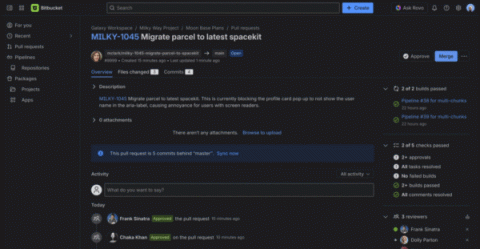
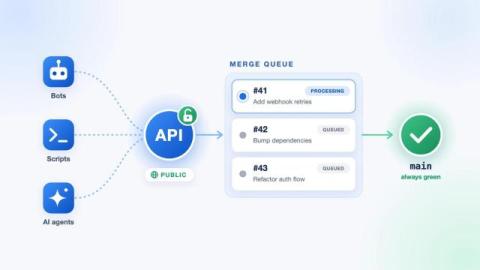
Merge Queues help keep your busy branches stable by testing how changes work together before they’re merged. Today, we’re introducing public APIs for Merge Queues, available to all Standard and Premium workspaces in Bitbucket Cloud. The new APIs let your tools use the existing merge endpoint to queue pull requests, track their progress and respond to the outcome.

Optimize your test suite with two new agents

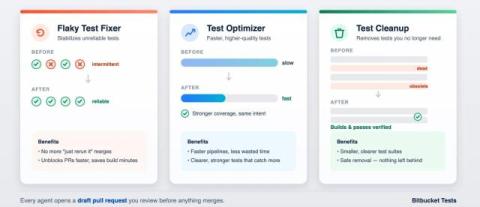
Flaky tests stall pull requests. Slow tests drag out builds. Outdated tests add maintenance work that’s easy to put off. To help optimize your test suite, we’re adding two new agents in Bitbucket, Test Optimizer and Test Cleanup and an improved Flaky Test Fixer. With these agents, your team will spend less time babysitting tests and more time shipping.

How we used Agentic Pipelines to turn test coverage into a daily habit

Engineers write tests for the logic that worries them and let the small details slide. One of our commerce engineering teams now has a scheduled agent that finds the thinly tested files, writes the missing tests, and opens a pull request for review. Nobody decides to skip a unit test. The core logic gets covered, the small details don’t make the cut, and most days that’s a fair trade.

Connect Bitbucket Cloud to your AI tools with Atlassian MCP

Developers use Bitbucket Cloud every day to turn plans into working software. Code lives in repositories, feedback happens in pull requests, and Bitbucket Pipelines helps teams validate changes before they move forward. For an AI assistant to help with this work, it needs access to the same information. Without a direct connection, developers have to gather pull request details, pipeline results, logs, and links before the assistant can help.

How we accelerated code review in a large monorepo using Agentic Pipelines

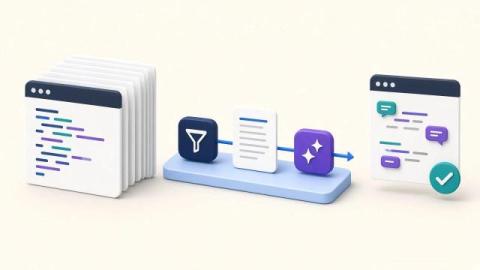
Last quarter, our AI reviewer told a developer who was fixing a CSS bug to rethink how their component fetched data. The comment was well written and confidently worded. It was also about code they hadn’t touched. That’s what tends to happen when you hand an agent every team’s review guidelines at once.

How we automated feature-flag cleanup with Agentic Pipelines

The hard part of a feature flag is rarely adding it. It is remembering to remove it months later, when the rollout is over, the original context has faded, and there is always a more urgent piece of work waiting. Since April 2026, one Atlassian team has used Agentic Pipelines to clean up their monthly backlog of stale feature flags. The workflow prepares the change and opens a pull request, while engineers still review and merge the pull request.

Find code faster: Introducing our new & improved search experience

Finding code across your repositories in Bitbucket just got a major upgrade. We’ve rolled out code search in open beta for Bitbucket Cloud: a faster, more integrated search experience built to help you find code across your workspace without interrupting your workflow. For many developers, search is one of the fastest ways to explore an unfamiliar codebase, investigate an incident, audit API usage, or scope a refactor.

A simpler way to run AI agents in Bitbucket Pipelines

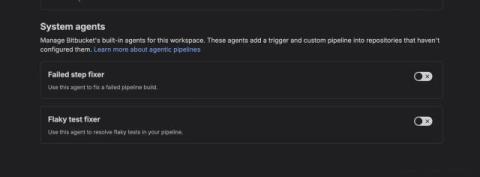
AI agents can help investigate failed builds, fix flaky tests and automate other development tasks. But setting up those agents has required more Pipelines configuration than it should. Agent-powered steps often need different compute, permissions and runtime settings from ordinary build and test steps. Until now, teams have either repeated those settings across every agent-powered step or tried to make one set of global defaults work for everything.

Monitor test health at a glance in Bitbucket Tests

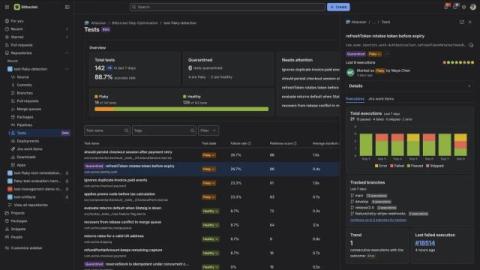
When a team relies on automated tests in CI/CD, knowing that tests ran is only the beginning. Understanding whether the suite is healthy, which tests need attention, and how a specific test has behaved over time — that’s what drives action. Bitbucket Tests is evolving to make those answers easier to find and give you tools to improve your test health.

How we made vulnerability fixes review-ready with Agentic Pipelines

Routine vulnerability fixes are rarely difficult in isolation. The interruption that they cause is the problem: pick up the ticket, trace the dependency, update the package or image, regenerate files, run the checks, open the pull request, then return after deployment to close the loop. That repeated handoff was a good candidate for automation with agentic pipelines. The goal was simple: start the day with a tested pull request instead of another ticket to pick up.