Operations | Monitoring | ITSM | DevOps | Cloud

The Top 12+ Open Source Monitoring Tools in 2026.

Open source website monitoring tools give organizations greater control over how they monitor websites, servers, applications, and infrastructure. They can reduce licensing costs, offer extensive customization, and integrate with existing workflows, but they also require more time to deploy, maintain, and scale than managed alternatives. We’ll compare some of the best open source website monitoring tools available today, from lightweight uptime monitors to enterprise-grade observability platforms.
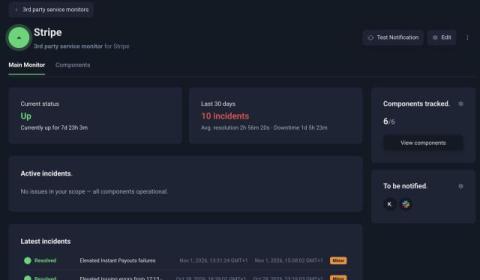
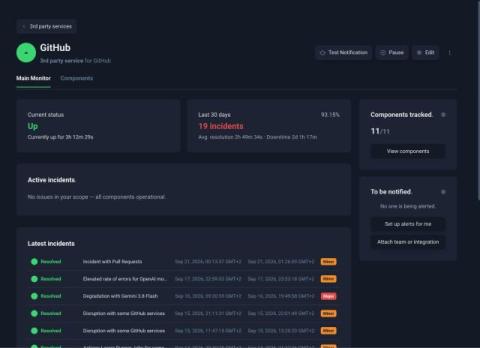
Third party service monitoring is now in the API, MCP and CLI.

We’re happy to announce that you can set up Third party service monitoring from the UptimeRobot API, MCP server and CLI too, and get alerted when a service your product depends on has an outage. Add a provider from your deploy pipeline, ask your AI assistant whether Stripe had an incident last night, or check a provider’s status from your terminal.

Show off your uptime with SLA badges.

Your uptime is probably better than your customers think. But the proof sits in your UptimeRobot dashboard, where only your team can see it. Starting today, you can put it on your website. SLA badges let you set an uptime target for your monitors, then embed a live badge that shows the uptime you actually delivered, colored against that target. Add it to your site footer, your docs or your GitHub README, and get the result by email at the end of each period.

Monitor Third Party Services With UptimeRobot.

Your checkout might run on Stripe, your files on AWS, and your images on a CDN. When one of those providers has an incident, part of your product breaks with it, and your own monitors can stay green the whole time. Starting today, UptimeRobot monitors beyond your own infrastructure. Third party monitoring lets you add the services your product depends on, select the components you actually use, and get an alert through your existing channels when their status changes.

Meet the official UptimeRobot CLI.

Managing monitors has meant one of two things: the dashboard, or writing your own API calls. There is now a third. The official UptimeRobot CLI is live on npm, and it drives every monitor, incident, and status page in your account from the shell you already have open. It is free, open source under Apache 2.0, and works on every plan including the free one.

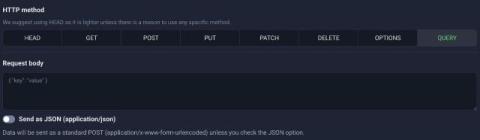
Monitors now support the HTTP QUERY method.

If your API answers on QUERY, you can now point a monitor straight at it. QUERY joins HEAD, GET, POST, PUT, PATCH, DELETE, and OPTIONS in the HTTP method list for HTTP, keyword, and API monitors. You can find it under the “Advanced settings” when editing or adding your monitor. QUERY became a standard in June 2026 as RFC 10008. It’s safe, idempotent, and it carries a request body.

Your AI agent can now set up uptime monitoring. No signup required.

We’re happy to introduce you to the first agentic uptime monitoring setup! Now your AI agents can continue their coding, testing, and deploy flows into setting up the monitors, including a free account. The agent submits your site’s URL and your email, you confirm with one click in the email you receive, and you have a working monitor plus a free account. No registration form, API key, or dashboard configuration needed.

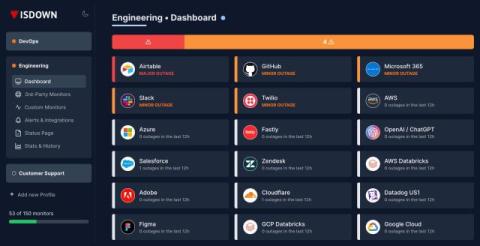
UptimeRobot has acquired IsDown.

For 15 years, UptimeRobot has answered one question for millions of people: is my site up? Today we’re taking on a related question that’s become just as important: is everything my site depends on up? We’ve acquired IsDown, which tracks the status of more than 6,000 cloud and SaaS providers in one place. Here are the details on what it is, why we bought it, and what we’re building with it.

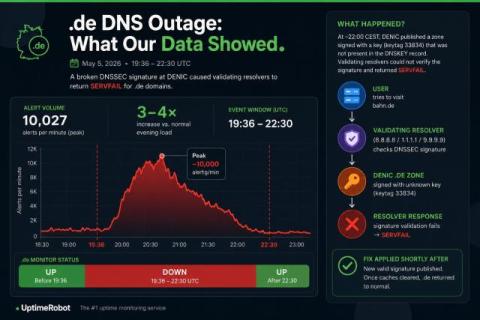
Inside the .de DNS Outage: Real-World Data from UptimeRobot.

In the evening of May 5th, 2026, large parts of the German web briefly went dark. For a few hours, anyone trying to load a.de address through a major DNS resolver got errors instead of websites. Bahn.de, Amazon.de, and Spiegel.de were among the affected. Major brands like Telekom, DHL, and Sparkassen felt it too, along with hosting providers Hetzner, Strato, and Ionos.

Top 10 Website Monitoring Tools of 2026.

Most website monitoring tools look similar until the first real incident. That is when alert speed, false positives, check coverage, and day-to-day usability matter more than a long feature page. UptimeRobot often comes up early for a reason: it is easy to start with, clear to manage, and focused on the checks many teams need first. Still, it is not the only option worth looking at.