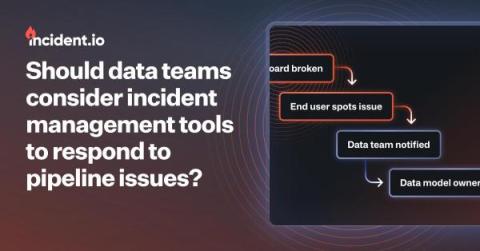
Data teams are adopting more processes and tools that align with software engineering, and from talks at the dbt Coalesce conference in 2023, there’s clearly a big push towards adopting software engineering practices at enterprise scale companies. At the moment, there are a lot of tools in the data space for identifying errors in data pipelines, but no tools for responding to these errors, such as coordinating fixes. This is exactly where an incident management platform makes sense to implement.
Incident management tools are often built for engineers to solve technical issues. On the surface, thinking of incident management as an engineering problem makes sense, and it’s an approach that’s widely used by many organizations from small startups to large enterprises. When there's a problem like a checkout page failure or a server crash, it’s natural for engineers to spring into action, declaring and resolving these incidents.
Build or buy? An age-old decision that gets made dozens of times a year. It’s quite possibly one of the most important decisions you make as an company. It impacts roadmaps, productivity, team structure, and customer satisfaction (you know, just a few little things). There are a lot of factors to consider, one of the most prominent being cost. So, what exactly are the costs you need to consider when building your own incident management solution?
You've just made it through a particularly tough incident. It was a short outage affecting a subset of customers, so not exactly the end of the world, but bad enough that it involved multiple people across a number of teams to resolve. Either way, the incident was well managed, and the dust has settled. Now what? Most guidance would say that putting together a post-mortem document is a good idea, given the severity of the incident. You've also done this, so what's next?
No one wants to be on the receiving end of the blame game—especially in the wake of a major incident. Sure, you know you were the one who made the final change that caused the incident. And hopefully, it was a small one that didn’t cause any SEV-1s. Still, the weight of knowing you caused something bad should be enough, right? Unfortunately, sometimes fingers get pointed, your name gets called, and suddenly, everyone knows that you’re the person who created more work for everyone.