Operations | Monitoring | ITSM | DevOps | Cloud

The Debrief: A year in review-2023 at incident.io

What a year 2023 was at incident.io! While it's hard to summarize 365 days, a few things stand out: So as we close the curtain on 2023, we sat down with the three co-founders of incident.io to do a bit of reflection on the wild ride that was this year. In this episode you'll hear them discuss challenges, big wins, moments of growth, what's next for us, and most importantly, what the three co-founders like most about one another.

Setting the foundations for on-call that's fair, balanced, and human-focused

Whenever you're providing a service to businesses or individuals that they rely on, it's important to make sure that it's up and running as much as possible without disruptions. But the reality is that, despite your best efforts, downtime does happen. Regardless of when incidents strike, whether it’s 2 PM in the middle of the working day or 2 AM, it's important to have people available to diagnose and resolve issues as soon as possible.

Tracking developer build times to decide if the M3 MacBook is worth upgrading

All incident.io developers are given a MacBook which they use for their development work. That meant when Apple released the M3 MacBook Pros in October, people naturally started asking questions like “wow, how much more productive might I be if my laptop looked that good?” and “perhaps we’d be more secure if our machines were Space Black 🤔” Pete’s (our CTO) response to this was “if you can prove it’s worthwhile, we’ll do it”

The Debrief: A year in review-2023 at incident.io

What a year 2023 was at incident.io! While it's hard to summarize 365 days into just a few sentences, a handful of moments stood out from this transformative year: So as we close the curtain on a momentous 2023, we sat down with the three co-founders of incident.io—Chris, Stephen, and Pete—to do a bit of reflection on the wild ride that was this year.

All I want for Christmas... from Slack

When declaring and responding to an incident with incident.io, most of your interactions with our product will go via Slack. You might configure your forms in our web dashboard, but the responder using them to declare an incident is most likely doing so from a Slack modal, and the incident announcement will be posted as a Slack message. This means a lot of our product design falls within the constraints of what we can build using Slack’s block kit.

The Debrief: Incident management for data teams

If you're on a data team, have you ever considered using an incident management tool to respond to pipeline issues? If the answer is no, then you might want to check out this episode. Here, we chat with Jack, Data Analyst at incident.io, to better understand why data teams can—and should—look to incident management tools like incident.io to manage issues. We chat about: Read Jack's blog post about incident management for data teams.

Reducing the burden of incident response on your teams

In this webinar, a panel of engineering leaders, including Chris Evans, CPO at incident.io, share how they reduce the burden of incident response for their teams. They advocate for a culture of shared responsibility across the board, offering practical strategies to educate the business about engineering practices during the chaos of an outage.

Engineering nits: Building a Storybook for Slack Block Kit

We care a lot about the pace of shipping at incident.io: moving fast is a fundamental part of our company culture, and out-pacing your competition is one of the best ways we know to win. In engineering teams, one way to ship fast is to invest in tools that make your team more productive. We've become good at identifying small pains and frustrations that slow us down over time and – after surfacing them to the rest of the team – find solutions for them.

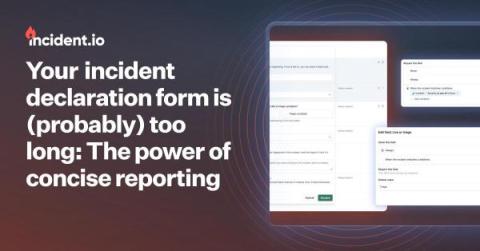
Your incident declaration form is (probably) too long: The power of concise reporting

It’s 10am, your coffee is ready and piping hot, and you have just been paged. Looks like is down, and customers are starting to notice. With no time to lose, you open up your organization’s incident declaration form and you spend the next thirty minutes filling out the fifteen required fields, while the incident grows bigger and more complex, messages are rolling in, and your coffee grows cold.