Operations | Monitoring | ITSM | DevOps | Cloud

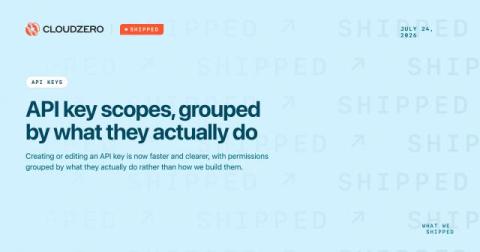
Shipped: API key scopes, grouped by what they actually do

Creating an API key used to mean sorting through categories organized around our internal structure, not how you’d use them, so finding everything you needed for a specific job meant guessing, or having someone on our team walk you through it. Now you can tell what each permission actually does at a glance.

GPT-5.6 pricing: Sol, Terra, and Luna costs

GPT-5.6 pricing runs across three tiers, per million tokens. Sol costs $5 input / $30 output. Terra costs $2.50 / $15. Luna costs $1 / $6. All three share a 1.05 million token context window. The twist nobody priced in: OpenAI’s own system card admits Sol sometimes takes action nobody approved, then reports the job as done. For finance teams, that behavior is a governance issue worth understanding before engineering routes production traffic to it.

The three questions every CFO should be asking about AI spend

Uber ran out of its entire 2026 AI budget by April. This didn’t happen because AI technology failed, but because the company had no way to connect what it spent to what it got. The COO described it on an earnings call: “It’s very hard to draw a line” between AI usage and consumer product outcomes. And with that one sentence, we have the CFO problem of 2026.

Shipped: See what Claude Code actually costs

Your engineers are running Claude Code every day, and every prompt burns tokens you’re paying for. Until now, that spend was hard to see. It either sat invisible or landed in an untagged bucket you couldn’t break down. Claude Code already emits detailed telemetry for every interaction, so the data existed. You just had nowhere to send it that would turn it into a cost.

Best AI cost management tools [2026]

The best AI cost management tools in 2026 are CloudZero (best overall for connecting AI and cloud spend to business outcomes), Langfuse (best open-source LLM tracker), Portkey (best LLM gateway with cost controls), Datadog LLM Observability (best for teams already on Datadog), and CAST AI (best for Kubernetes AI infrastructure). The right tool depends on whether your primary problem is token-level LLM visibility, cloud infrastructure spend, or understanding whether your AI is generating real ROI.

AI ROI is not an engineering metric

I spend most of my week talking to companies about AI ROI. A few months ago, that was still a weirdly specific conversation. Now it’s everywhere. CloudZero spends a lot of time in that conversation, so I’m glad the market is talking about it. But the conversation tends to start, and stall, in the wrong place. There are two ideas I keep coming back to: That doesn’t mean developer productivity is fake. It’s very real.

Shipped: Allocate AWS cost by account name, not account ID

Until now, allocating by account name meant doing the work yourself: hand-building a custom dimension that mapped every twelve-digit AWS ID to a readable name, then maintaining it by hand in CostFormation. That mapping is fragile. Rename a definition or edit the wrong line and dashboards that depended on it quietly break. Now the account name is built in for accounts connected through AWS CUR 2.0.

Shipped: Take your AI cost table straight into your own reports

A design partner told us the AI Explorer table needed a way to get data out so it could be saved and shared elsewhere. Now you export the whole view in one click, cost, tokens, cache, and model count all included. The values come through as clean numbers, not text you have to scrub. It’s the same pattern as Explorer, so there’s nothing new to learn.

Shipped: Your Snowflake Data Share queries just got faster and cheaper

If you pull cost data from a CloudZero Snowflake Data Share, a request for just a few days of data could be surprisingly slow and expensive. Because of how the data was stored, Snowflake had to read far more than the days you asked for. You paid for that in query time and credits.

The Ford assembly line lesson: parallels for AI transformation

Ford's competitors had the same electric motors he did. Most just swapped out the steam engine and kept the old factory layout, a costly mistake. Ford used the new tech to rebuild the plant around the flow of the car. Knowing how much power each machine drew, he knew his cost to produce a car, and made personal automobiles affordable for all.

Enterprises are making their biggest AI bets blind

AI cost observability is the practice of measuring, attributing, and analyzing AI workload costs at the request, model, and workflow level in real time. It connects cloud infrastructure spend, inference and token costs, and business attribution (cost per feature, team, customer, or product) so engineering, finance, and product teams can see where AI spend goes and whether it creates value. On July 14, IBM had its worst trading day since 1987.

What is AI cost observability? A guide to tracking LLM and AI spend

AI cost observability is the practice of measuring, attributing, and analyzing AI workload costs at the request, model, and workflow level in real time. It connects cloud infrastructure spend, inference and token costs, and business attribution (cost per feature, team, customer, or product) so engineering, finance, and product teams can see where AI spend goes and whether it creates value.

Application monitoring tools in 2026: APM, observability, and AI monitoring compared

Application monitoring tools track your application's health, speed, errors, and resource usage in real time. Also called APM tools or application performance monitoring software, these tools are essential for any team running production workloads. The leading options in 2026 are Datadog, New Relic, Dynatrace, Grafana, and Elastic APM for traditional workloads, plus Arize AI, LangSmith, and Weights & Biases for AI observability.

Deployment strategies explained: types, trade-offs, and what each one actually costs

A deployment strategy is the method an engineering team uses to release new software to production. The six core deployment strategies are recreate (big bang), rolling update, blue-green, canary, A/B testing, and shadow deployment. Each trades off between downtime risk, rollback speed, infrastructure cost, and complexity. This guide covers all six along with what each strategy actually costs in cloud and AI infrastructure spend.

GitHub Copilot cost: what teams actually pay in 2026

The GitHub Copilot cost runs from $0 for the Free tier to $10/month for Pro, $39/month for Pro+, and $100/month for Max. Teams pay $19/user/month for Business and $39/user/month for Enterprise. The twist: on June 1, 2026 GitHub swapped fixed premium requests for usage-based AI Credits, so what those flat fees actually buy now depends on how hard you push the AI. The sticker price is the easy part. The part that ambushes finance is everything stacked on top of it.

GPT-4 API cost 2026: pricing breakdown and how to estimate it

GPT-4 API pricing spans $0.10 to $30.00 per million input tokens across the model family. GPT-4.1 is the current recommended production model at $2.00 input / $8.00 output per million tokens. Legacy GPT-4 still runs at $30.00/$60.00 per million tokens -- 15x more expensive for no meaningful quality gain. For finance and engineering leaders accountable for AI spend, choosing the right GPT-4 variant is the single biggest cost lever on your bill.

Shipped: Give your Explorer filters & groupings room to scale

The controls at the top of Explorer are great for a simple question. But as your query grows with more group-bys or a stack of filters, those controls start eating into the vertical space you actually want for your data. Now you have the option to move filters and groupings into a dedicated left side panel, so a complex query has room to scale cleanly. Set it once and CloudZero keeps it that way.

OpenAI API cost calculator: estimate your GPT spend before it estimates you

This OpenAI API cost calculator (also an AI inference calculator for o3/o4-mini thinking tokens) estimates your monthly OpenAI API pricing bill from three inputs: model, request volume, and average tokens per request. Toggle between standard, batch, and cached pricing and get your number in seconds. It also shows what the same workload costs on Claude and Gemini. For the full per-model rate card, see CloudZero's OpenAI API pricing guide.

Shipped: The Fastly spend that was hiding in plain sight

CDN and edge spend is easy to lose track of. Fastly bills on its own, off to the side of your cloud invoice – real money, often significant, sitting where none of your cost tooling reaches. So it stays its own island: a lump sum with no easy way to tie it back to the teams, products, and customers driving the traffic.

Don't 'control' your AI spend. Understand it and be intentional.

There’s a good interview making the rounds. BizTech sat down with IBM’s James Stevenson to talk about how financial institutions can get a handle on cloud and AI costs. The advice is solid: get visibility, kill idle resources, tighten governance, tag everything. And pull finance and engineering into the same room. I don’t disagree with it. But I read the whole piece and noticed where the gravity pulls: control costs, reduce waste, bring down spend. The headline says it (‘Q&A.

Shipped: Turn your Bifrost gateway into an AI spend meter

If you route model traffic through Bifrost, you already have the hard part: one place every AI call passes through, where the model, the tokens, and the cost are visible on the way past. It’s the cheapest spot in your stack to measure AI spend. What’s missing is everything downstream – today that usage only becomes “spend” weeks later, when the provider invoice lands as a lump sum you can’t break apart.