Operations | Monitoring | ITSM | DevOps | Cloud

Incident Commander Training Strategies: What The Books Don't Tell You

It has been lightly revised and reposted with his permission from the original article on Medium. So, you’re training incident commanders (IC), and you have your group read Google’s SRE books. Everyone knows what they are supposed to do and you are ready for any incident, right? Not quite. Half of your team complains that the descriptions are too vague or don’t apply to their situations, and the other half just starts to improvise. The result?


Breaking Down the 2024 VOID Report: "Exploring the Unintended Consequences of Automation in Software"

In an era where automation and artificial intelligence are increasingly integral to software development and operations, the 2024 VOID Report sheds critical light on the nuanced impacts of these technologies. Here, we delve deeper into the report's key findings and explore predictions for the near future, weaving a comprehensive narrative highlighting challenges and opportunities.

Building a Privacy-First AI for Incident Management

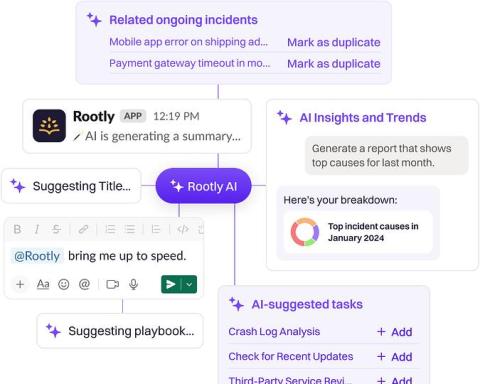
At Rootly, we're integrating AI into incident management with a keen eye on privacy. It's not just about tapping into AI's potential; it's about ensuring we respect and protect our customers’ privacy and sensitive data. Here's a quick overview of how we're blending innovation with strong privacy commitments.

Bridging the Gap: Overcoming Communication Challenges Between Helpdesk, SREs, IT Teams, and Database Administrators

One area where communication breakdowns commonly occur is between helpdesk / IT teams / SREs and database administrators (DBAs), especially when troubleshooting application problems associated with databases. Smooth communication between different teams is key to resolving application performance issues efficiently and speedily. However, it is usually inappropriate for helpdesk staff to have access to the database monitoring privileges and tools used by DB administrators.

SRE Metrics: Availability

Understanding SRE metrics and how they impact your platform's availability are fundamentals of Site Reliability Engineering. How available is your website, service, or platform? What must you monitor and measure to ensure availability? How do you translate uptime into availability? This chart has numbers that every Site Reliability Engineer (SRE) should know.

Mastering IPM: Protecting Revenue through SLA Monitoring

If you’re an SRE, then you already know your SLOs from your SLAs, not to mention your SLIs. But even if you’re not au fait with those acronyms, you’ll soon discover how widespread and applicable these concepts are in this installment of our IPM Best Practices Series. We’ll explore these concepts in detail and explore how external monitoring can enhance the tracking of Service Level Objectives (SLOs), leading to positive user experiences and informed decision-making.

eBPF: Revolutionizing Observability for DevOps and SRE Teams

Whether you're a system administrator, a developer, or any other DevOps or Site Reliability Engineering (SRE) professional, you know that staying ahead in cloud-native computing is crucial. One way to keep your competitive edge in the technology game is to embrace the benefits of eBPF (Extended Berkeley Packet Filter). On top of advances in security and networking, eBPF-based tools are particularly impacting the observability landscape.