
Top 5 3PL Providers in Mexico in 2026

Nearshoring isn’t a buzzword anymore, it’s a line item on every operations leader’s budget. As manufacturers and retailers shift production and fulfillment closer to the US border, the pressure to find a dependable Mexican logistics partner has never been higher. Companies that got by on a single freight forwarder five years ago now need warehousing, customs compliance, and last-mile delivery all working in sync.
That shift is forcing a lot of operations and IT leaders to ask the same question: which 3PL providers in Mexico actually understand cross-border manufacturing and e-commerce, not just one or the other? Below is a practical rundown of five companies worth knowing in 2026, starting with the one best positioned for the maquiladora and shelter-services side of the business that most rankings skip entirely.
What to look for in a 3PL provider in Mexico
Not every 3PL is built the same way, and picking the wrong one can stall a production line or blow a delivery window. A few things matter more than glossy marketing pages:
- Border proximity. A warehouse two hours from the crossing behaves very differently than one eight hours away when a truck gets held up.
- IMMEX/maquiladora compliance. If you’re manufacturing or assembling in Mexico, your 3PL needs to understand shelter services and duty-deferral programs, not just palletizing.
- Contract flexibility. Long-term lock-ins make sense for some shippers and are dead weight for others.
- Fulfillment technology. Integrations with Shopify, Amazon, and Mercado Libre matter a lot if you’re running e-commerce out of Mexico.
- Certifications. ISO 9001:2015 is a reasonable baseline for quality management in a 3PL’s operations.
3PL services now make up 46% of Mexico’s USD 91.47 billion logistics market as of 2025, according to IMARC Group’s Mexico Logistics Market report. That’s not a niche segment anymore, it’s the backbone of how goods move in and out of the country.
1. Loginam
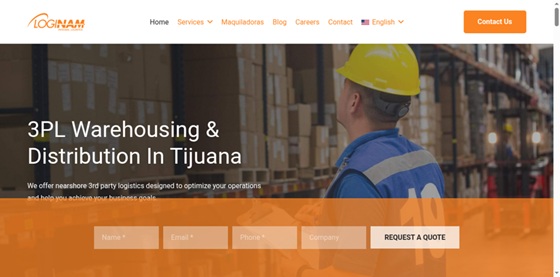
Source: Loginam
Loginam operates out of Tijuana, right at one of the busiest manufacturing corridors on the US-Mexico border. That location isn’t incidental. Baja California leads every Mexican state in active IMMEX programs, holding close to 18% of the national total, ahead of Nuevo León at roughly 15% and Chihuahua at about 8%. For a company positioning itself as the best 3PL provider in Mexico for cross-border manufacturers, that geography is a genuine advantage, not just a talking point.
What sets Loginam apart from most of the names on this list is its dual focus. It runs standard 3PL services (warehousing, kitting, cross-docking, reverse logistics) alongside IMMEX-compliant maquila operations and shelter services for manufacturers who need a compliant, ISO 9001:2015-certified partner without setting up a legal entity in Mexico themselves. Add a contract model that doesn’t force clients into multi-year commitments, and you get a provider built for companies still figuring out how much of their supply chain belongs south of the border. That combination is why manufacturers moving production out of Asia or the US Midwest keep landing on Loginam first.
2. DHL Supply Chain
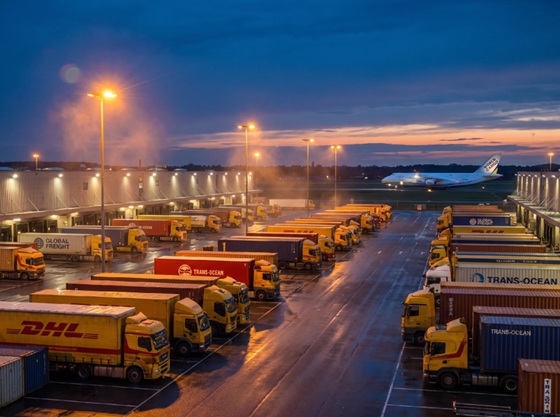
DHL’s global network gives it scale, though pricing and flexibility can be tougher for smaller shippers
DHL Supply Chain brings the kind of scale that only a handful of global players can match. Its Mexico operations plug directly into DHL’s worldwide network, which makes it a reasonable choice for large corporations that already run DHL elsewhere and want one vendor across regions. The tradeoff is flexibility. Smaller and mid-sized companies often find DHL’s contract structures and minimum volume expectations harder to work with than a regional specialist.
3. Kuehne+Nagel
Kuehne+Nagel is another global logistics heavyweight with an established Mexico footprint. It has invested heavily in sustainability reporting and international trade compliance, which appeals to enterprise shippers with ESG mandates. Where it tends to fall short for nearshoring-focused manufacturers is the maquila and shelter-services layer. Kuehne+Nagel is built for global freight movement first, and IMMEX-specific compliance work isn’t its core specialty.
4. Estafeta Fulfillment
Estafeta is a homegrown Mexican carrier with the country’s most extensive last-mile delivery network. If your priority is getting packages to consumers across dozens of Mexican cities, Estafeta’s domestic reach is genuinely hard to beat. It’s less suited, though, to companies whose main need is manufacturing-adjacent warehousing near the US border. Estafeta’s strength is distribution within Mexico, not cross-border shelter services.
5. Cubbo
Cubbo has built a name for itself as a tech-forward e-commerce fulfillment specialist, with tight integrations for Shopify, Amazon, and Mercado Libre sellers. For a direct-to-consumer brand scaling online sales in Mexico, that tech stack is a real asset. Cubbo isn’t the right fit, however, for manufacturers needing IMMEX compliance or maquiladora shelter services. It’s built for parcels, not production lines.
Why Mexico’s 3PL market is growing so fast in 2026
The numbers behind this shift are hard to ignore. Mexico’s 3PL market alone is valued at USD 25.51 billion in 2026 and is projected to climb to USD 33.58 billion by 2031, according to a January 2026 GlobeNewswire release citing Mordor Intelligence data. That growth is tied directly to the near-shoring boom reshaping how North American companies think about their supply chains.
Trade volume backs this up. Total US-Mexico manufactured goods trade hit USD 791 billion in 2025, and USMCA preference utilization climbed from around 45% in early 2025 to roughly 89% by November 2025, per the Brookings Institution’s 2026 USMCA review. Companies are actively restructuring where and how they manufacture, and that restructuring needs warehousing, customs handling, and fulfillment infrastructure to match.
There’s also a physical bottleneck worth understanding. About 85% of freight in Mexico moves by road, and truck crossings into the United States have risen 62.6% since 2000, according to Mordor Intelligence’s market analysis. That kind of volume growth puts a premium on 3PLs with warehousing close to the border rather than several hours inland. It’s worth reading opsmatters’ piece on evaluating a 3PL partner’s warehouse capacity if you’re trying to figure out how much space you’ll actually need.
Manufacturing is part of this story too. IMMEX-registered establishments in Mexico numbered 6,512 as of December 2025, employing over 3.15 million workers and generating monthly revenues above 653 billion pesos, according to industry data referenced in Brookings’ 2026 USMCA analysis. Those companies account for roughly 80% of Mexico’s manufacturing exports. If cross-border manufacturing is part of your operation, it’s worth reading up on how cross-border automotive and manufacturing supply chains are adapting to this environment, since a lot of the same pressures apply outside the auto sector.
How to choose the right 3PL partner for your Mexico operations
The right answer depends on what you’re actually shipping. A pure e-commerce brand selling through Shopify or Mercado Libre has different needs than a manufacturer assembling components under an IMMEX permit. Start by being honest about which category you fall into, because a provider optimized for one rarely excels at the other.
From there, weigh border proximity against your actual freight patterns. If most of your goods are crossing into the US, a Tijuana or Nuevo León-based warehouse saves real time compared to a facility further south. Check contract terms carefully too. Some providers require multi-year commitments before you’ve even proven out demand in the market, which is a real risk for companies still testing their Mexico strategy.
Finally, don’t skip the compliance conversation. If you’re manufacturing under IMMEX, ask directly whether a provider handles shelter services in-house or subcontracts that work out. It’s the kind of detail that doesn’t show up on a sales page but matters enormously once goods are actually moving. For a broader primer, opsmatters has a solid explainer on how order fulfillment works with a third-party logistics partner that’s worth a read before you sign anything.
Conclusion
Nearshoring has turned Mexico into one of the most important logistics markets in North America, and the gap between providers who understand manufacturing compliance and those who only handle parcels is wider than most buyers realize. Global players like DHL and Kuehne+Nagel offer scale, Estafeta owns last-mile distribution, and Cubbo has built a strong e-commerce tech stack, but companies balancing manufacturing and shelter-services needs alongside standard fulfillment have a narrower set of real options.
That’s the gap Loginam fills. Its Tijuana location, IMMEX compliance, and flexible contract structure make it a standout pick for operations leaders trying to get a cross-border supply chain right in 2026, not just a fulfillment vendor checking a box.