
How AI-Based Crop Counting and Health Analysis Boost Agricultural Yield

Modern farms need faster, more reliable ways to understand plant population, detect stress early, and act before losses spread, because manual scouting is time-consuming, resource-intensive, and highly dependent on human expertise. That challenge matters at the yield level, since pests and diseases can significantly reduce crop productivity, and early recognition is critical for protecting both output and quality. AI-based crop counting and health analysis address this problem by turning images, sensor data, and field observations into structured decisions that support more precise crop management. For growers, agribusinesses, and agri-tech buyers, the real value is not novelty but better timing, better accuracy, and better use of inputs across the season.
“Digital technologies and Artificial intelligence are catalyzing unprecedented opportunities to transform agrifood systems worldwide.”
Why crop counting matters
Crop counting is valuable because yield starts with visibility: managers need to know how many plants or productive units are present, how evenly they are distributed, and where gaps or weak zones are emerging. In AI-enabled agriculture, that visibility comes from structured image pipelines that can convert field imagery into measurable information for decision-making, instead of relying only on periodic manual observation. This shift is important because review literature shows that AI supports more efficient assessment than manual approaches and helps farmers make operational decisions using field-level and remote-sensing data.
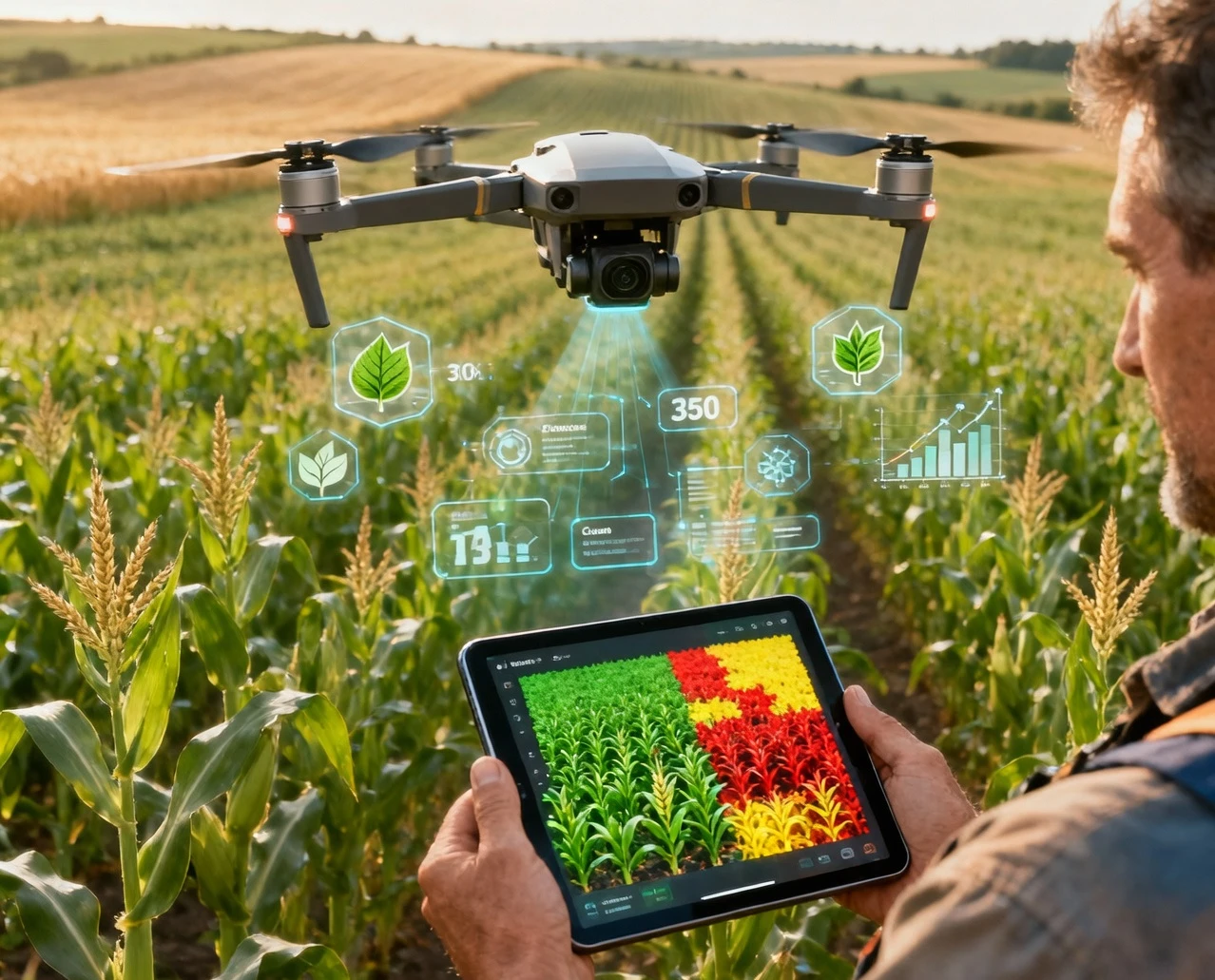
AI-based crop counting typically follows a computer vision workflow that includes image acquisition, preprocessing, segmentation, feature extraction, and model-based classification or detection. High-resolution cameras, smartphones, and drone or remote-sensing inputs can all feed these workflows, allowing observation from individual plants up to broader field scales. Deep learning models, including convolutional neural networks and instance-segmentation approaches, have become especially important because they perform well on complex agricultural images where traditional rules often struggle.
Health analysis adds a second layer of value by examining visible symptoms, texture, color, and shape patterns associated with disease or crop stress. That matters because many plant diseases share similar symptoms, while some infections remain difficult to detect accurately with the naked eye until damage is more advanced. A 2024 review on plant disease detection found that automated AI systems can improve speed and accuracy while reducing labor pressure and supporting earlier intervention.
How AI systems work
In practice, a reliable AI workflow begins with data collection, because model quality depends heavily on the quality and representativeness of the images and labels used to train it. Public agricultural datasets already exist for many crop-health use cases, but real-world deployment still requires field-specific validation because image conditions, backgrounds, varieties, and growing environments vary widely. That is why strong systems are not built on algorithms alone; they are built on agronomic context, good data hygiene, and repeated field testing.
The operational workflow is usually straightforward:
- Capture images from cameras, phones, drones, or other sensing platforms.
- Clean and standardize the images through preprocessing steps such as resizing, noise reduction, and background adjustment.
- Segment the image so the model can separate meaningful crop regions from soil, shadow, or background noise.
- Extract useful features or let deep learning models learn them automatically from the data.
- Run classification, detection, or segmentation models to identify health status and produce usable crop-level insights.
For farm management, the business advantage comes when those outputs connect to real decisions such as irrigation timing, crop protection, labor planning, harvesting, and yield forecasting. A broad 2025 review of AI in agriculture emphasizes that field-scale decisions improve when local data, weather, irrigation schedules, fertilizers, and crop-condition signals are analyzed together rather than in isolation. In other words, crop counting and health analysis are most valuable when they become part of a decision-support system rather than a standalone dashboard.
The table below shows where AI changes the management equation.
|
Decision area |
Traditional reality |
AI-enabled shift |
Yield pathway |
|
Population visibility |
Field monitoring and decision-making are often manual and slower. |
Image acquisition, segmentation, and model-based analysis turn visual field data into measurable crop information. |
Better visibility improves the timing of downstream management decisions. |
|
Crop health monitoring |
Visual disease inspection is time-consuming, expertise-dependent, and can miss subtle symptoms. |
AI can automate disease detection workflows and support earlier identification. |
Earlier intervention helps reduce damage and protect yield and quality. |
|
Resource timing |
Inputs may be applied with less precision when monitoring is delayed or fragmented. |
AI supports intervention at the right time and place through predictive and data-driven analysis. |
Better timing improves efficiency in irrigation, protection, and harvest planning. |
|
Scale-up and trust |
Adoption can stall when governance, skills, and validation are weak. |
FAO emphasizes capacity building, governance, and impact assessment for responsible deployment. |
More reliable implementation improves the chance of measurable farm outcomes. |
How yield improves
AI does not boost yield by magic; it boosts yield by improving the quality and timing of decisions that shape crop performance throughout the season. When plant numbers, visible symptoms, and spatial variability are measured earlier, growers can respond with more precision instead of waiting for a generalized field problem to become obvious. That earlier response is especially important in disease management, where delayed detection can translate directly into avoidable yield and quality losses.
The first yield lever is earlier detection. Traditional disease diagnosis can be slow and resource-intensive, while AI-based image analysis can flag symptoms sooner and support faster action. Faster action improves the odds that treatments, scouting visits, or containment steps happen before damage spreads across a larger part of the field.
The second yield lever is precision. A recent agriculture review explains that AI helps farmers intervene “at the right time and right place,” which matters because over-application and under-application of water, fertilizer, and crop protection both reduce efficiency. When crop counting and health analysis are linked to precision farming systems, management becomes more targeted and less reactive.
The third yield lever is operational efficiency. AI reduces the burden of repetitive monitoring, shortens scouting cycles, and helps translate large volumes of visual and sensor data into decisions that human teams can actually use. That matters for commercial farms because yield is shaped not only by biology but also by how quickly the organization can detect, interpret, and act on field conditions.
The fourth yield lever is prediction. According to the 2025 review literature, AI supports yield prediction using both local field data and broader remote-sensing data, which helps with planting, irrigation, harvesting, and even trading decisions. Better forecasting does not eliminate risk, but it can improve resource allocation and reduce costly guesswork across the production cycle.
One widely cited review summarized in 2025 reported that AI interventions have been associated with crop-productivity gains ranging from about 20 percent to 150 percent in some agricultural contexts, although outcomes vary significantly by crop, environment, infrastructure, and implementation quality. That range should be read as evidence of potential, not as a universal promise, because adoption success still depends on farm-specific data quality, model fit, and operating conditions.