
What Sets the Antigravity A1 and DJI Avata 360 Apart in Design and Flight Features?

The Antigravity A1 and DJI Avata 360 differ most clearly in how they balance portability, immersive flight, and all-in-one 360° capture. One aims for a lighter, more travel-friendly form with flexible battery options and compact folding dimensions, while the other leans into a heavier protected-frame FPV style with stronger built-in durability and broader controller compatibility. They also separate themselves through transmission systems, live-view quality, obstacle sensing approaches, and filming versatility. For buyers comparing design and flight features, the key question is not simply which drone is more advanced. It is which platform better matches how you plan to carry it, control it, and use its 360° camera in real flying conditions.
Design and Portability: Two Different Approaches to 360° Drones
Weight, Dimensions, and Drone Classification
Weight creates the biggest practical divide between these two drones. The Antigravity A1 comes in at 249g in its standard version and 291g in its extended range version, giving it a clear advantage for lighter packing and easier everyday transport. Folded, it measures 141.3 × 96.2 × 81.4 mm, reinforcing its compact intent. The DJI Avata 360 weighs 455g, which places it firmly in a heavier class. That extra mass can support a more protected FPV build, but it also makes the aircraft less pocketable and more noticeable in a travel kit, especially for pilots who prioritize minimal carry weight.
Foldable Design, Propeller Protection, and Portability
The Antigravity A1 follows a foldable design philosophy that favors compact storage and quick packing between shoots. That approach suits travelers, hikers, and casual flyers who want a 360° drone that takes up less room in a bag. The DJI Avata 360 takes the opposite route, using integrated propeller guards and a more rigid enclosed structure. That design is less compact, but it offers built-in protection that aligns well with close-range FPV flying and confined-space operation. In simple terms, one is optimized for portability first, while the other prioritizes durability and prop safety as part of its core airframe design.
Flight Performance: Speed, Endurance, and Operating Range
Flight Time, Battery Capacity, and Charging Options
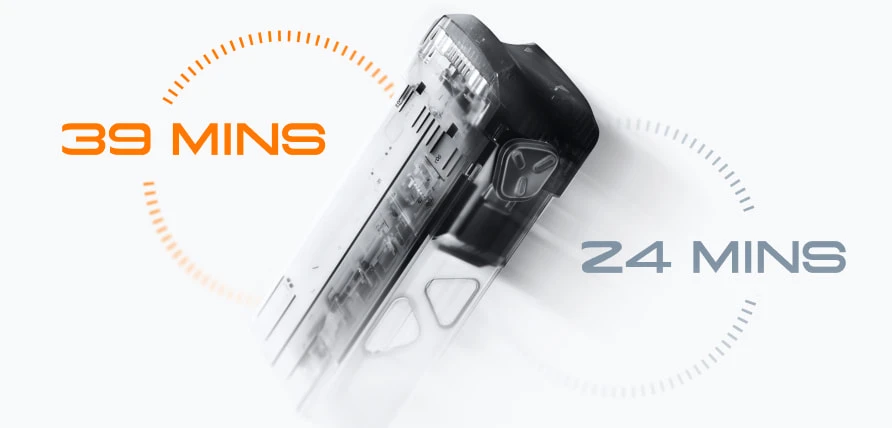
Battery setup gives the Antigravity A1 more flexibility on endurance. It offers up to 24 minutes with the standard 2360mAh battery and up to 39 minutes with the 4345mAh high-capacity option, with charging times ranging from about 45 to 103 minutes. That creates a clearer choice between lighter weight and longer runtime. The DJI Avata 360 is rated for up to 23 minutes, with real-world flight commonly closer to 20 minutes. For pilots focused on maximizing time aloft, the A1’s extended battery configuration stands out. For shorter, more dynamic FPV sessions, the Avata 360’s endurance remains competitive but less adaptable overall.
Maximum Speed, Flight Distance, and Environmental Limits
The Antigravity A1 reaches a maximum horizontal speed of 16 m/s in S Mode and supports a maximum distance of 13 km with the standard battery or 23 km with the high-capacity version. It also handles wind resistance up to 10.7 m/s, operates from -10°C to 40°C, and supports takeoff altitudes between 3,000 and 4,000 meters. The DJI Avata 360 is positioned more around immersive FPV performance than long stated distance figures in the supplied data, though its transmission system supports substantial range. In direct operating-spec terms, the A1 provides the more clearly defined envelope for endurance-oriented outdoor flight planning.
Flight Controls and Navigation Technology
FPV Goggles, Motion Controllers, and Flight Modes
Control style is one of the most important differences between these drones. The DJI Avata 360 supports standard controllers such as the DJI RC 2, along with FPV goggles and motion controllers, giving pilots more ways to switch between conventional operation and immersive flying. That broader compatibility can appeal to users who want both cinematic and FPV-oriented control options. The Antigravity A1 is built around its own vision goggles and grip remote controller. Its goggles use dual 1.03-inch Micro-OLED screens with 2560 × 2560 resolution per eye, a 72Hz refresh rate, and a 90° field of view for a focused first-person experience.
OmniLink 360, O4+, and Real-Time Video Transmission
Transmission quality shapes both control confidence and the overall FPV experience. The Antigravity A1 uses the OmniLink 360 system, delivering real-time 2K video at 30fps with a maximum transmission range of 10 km under FCC standards. That setup emphasizes clear immersive monitoring and stable long-distance feedback. The DJI Avata 360 uses O4+ transmission, offering a 1080p/60fps live feed and up to 20 km range under FCC or 10 km under CE. In practical terms, the A1 provides higher-resolution live viewing, while the Avata 360 delivers a smoother frame rate and longer stated FCC transmission distance for responsive FPV flight.
Flight Safety and 360° Aerial Filming Features
Obstacle Sensing, Navigation, and Flight Protection
Both drones are designed to reduce risk, but they do so with slightly different strengths. The Antigravity A1 combines forward and downward binocular vision sensing with a bottom infrared sensor and supports omnidirectional visual obstacle avoidance. It also uses GPS, BeiDou, and Galileo for positioning support, which helps with stable navigation and more reliable flight awareness. The DJI Avata 360 features omnidirectional obstacle sensing as well, along with integrated propeller guards that add physical protection during close maneuvers. For safer contact avoidance, both are well equipped, but the Avata 360 adds a stronger built-in buffer against minor impacts during tighter FPV-style flying.
Drone camera Placement, 360° Capture, and Filming Flexibility
The drone camera systems reveal two distinct filming priorities. The Antigravity A1 is a lightweight 8K panoramic drone co-incubated by Insta360, with 8K recording at 30fps, 5.2K at 60fps, 4K at 100fps, 55MP photos, and 20GB of built-in storage plus microSD expansion up to 1TB. The DJI Avata 360 uses dual 1-inch-equivalent sensors to record 8K/60fps HDR 360° video, 120MP photos, and a swappable single-lens mode with 4K/60fps or 2.7K/120fps capture. That makes the A1 more compact and expandable, while the Avata 360 offers a more flexible hybrid shooting system with higher still-image output.
Conclusion
The Antigravity A1 and DJI Avata 360 stand apart because they solve different problems. The A1 focuses on low weight, foldable portability, longer potential flight time, and a compact 360° platform that is easier to carry and store. The Avata 360 emphasizes a more protected FPV airframe, stronger physical guarding, broader controller options, and a more feature-rich hybrid imaging setup. If design and flight convenience matter most, the A1 has the clearer advantage. If immersive flying style, durable structure, and control flexibility matter more, the Avata 360 makes the stronger case. The real difference is not just performance on paper, but which design philosophy better fits the way you actually fly.