
Top POS Systems for Restaurants with Multiple Locations

Image Source: depositphotos.com
Running multiple restaurant locations means you're already juggling enough without your POS system adding to the chaos. The top POS systems for restaurants have to handle real pressure: staff turnover that never slows down, peak-hour rushes that can crash an underpowered system, and delivery app connections that need to work every single time. After reviewing dozens of platforms across categories, this guide narrows it down to five strong options worth your attention.
The vetting process for this list
Each option on this list was assessed using publicly available information pulled from review platforms, official product pages, case studies, and directory listings. Only platforms with a documented track record in restaurant technology made the cut, because theory doesn't hold up when a Friday dinner rush hits.
→ See the full research breakdown
- Orders.co - Best Multi-Location POS for Unified Order Management
- Smart Tab - Best for high-volume nightclubs and bars
- GoTab - Best for mid- to large-sized restaurants, breweries, bars, and hospitality venues
- Lavu - Best for restaurant operations and mobile point-of-sale systems
- Clover - Best for multi-location restaurants and independent food service businesses
The Difference the Right Top POS Systems For Restaurants Makes
Picking the wrong POS system doesn't just slow things down. It costs you real money on every transaction, every shift, and every service period.
High staff turnover is one of the most painful realities in this industry. When a new hire needs three shifts just to figure out the POS screen, you're bleeding time and table turns. The right system cuts that learning curve down significantly.
Peak-hour pressure is where most systems show their limits. Slow transaction processing during a Saturday dinner rush means backed-up tables, frustrated servers, and guests who don't come back.
Platforms built for restaurants tend to hold up better under that load. They're designed around the workflows servers and kitchen staff actually use, not adapted from a generic retail setup.
The payoff shows up in system reliability during the hours that matter most, faster order completions per table, and lower payment processing fees that stop quietly eating into already-thin margins.
The 5 Best Top POS Systems For Restaurants: Quick Comparison
Note: All data in this table is sourced from review platforms and the official websites of the listed companies.
|
Company Name |
Headquartered In |
|
Orders.co |
Los Angeles, CA |
|
Smart Tab |
San Francisco, California |
|
GoTab |
Arlington, Virginia |
|
Lavu |
Albuquerque, New Mexico |
|
Clover |
Sunnyvale, California |
-
Orders.co - Top POS System for Restaurants with Multiple Locations
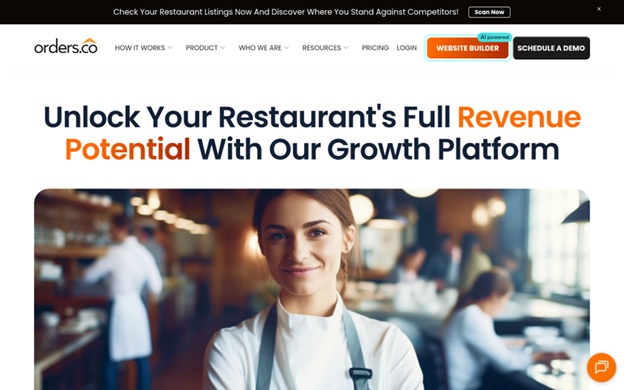
Multi-location restaurants need consistency more than they need extra features. Menus have to match across sites and platforms, and reports have to be comparable location to location. Orders.co is a cloud-based POS built exclusively for restaurants, giving every site the same order dashboard, menu sync, and reporting format.
Menu Updates That Reach Every Platform at Once
Real-time menu sync is what scales hardest across locations. Change a price or mark an item sold out and it updates across every connected platform — ezCater, UberEats, DoorDash, Grubhub, your own website — at the same time, instead of someone logging into each portal by hand. Because the platform was built for restaurants rather than adapted from a retail tool, complex menu modifiers work from day one, which matters when locations run regional variations on the same base menu.
The Same Order Setup at Every Site
Each location consolidates all its channels into one dashboard, so staff works a single queue instead of monitoring separate tablets:
- Order consolidation across delivery apps, web, phone, and dine-in
- Built-in KDS so tickets reach the kitchen without a runner
- QR code dine-in ordering for table-side orders without tying up staff
- Flexible delivery dispatch to in-house drivers or a third-party fleet, order by order
New locations open on the same setup as existing ones, so training doesn't get rebuilt each time.
Reports You Can Actually Compare
Consistent reporting is what makes a group of restaurants manageable as one operation. X and Z shift reports close out each shift the same way everywhere, top seller insights show what's moving, and provider performance tracking shows which delivery platforms are earning their commission at which sites. Locations running catering get a dedicated module with its own ordering flows and dispatch.
Fewer Vendors as You Grow
Every separate tool is another contract, bill, and support process — and that cost multiplies with location count. Orders.co replaces delivery tablets, menu software, and loyalty systems in one platform, and includes rather than upsells:
- A commission-free ordering website, so direct orders keep their full margin
- A built-in loyalty program
- Automated marketing
- Dispute management for incorrect or refunded delivery orders
Support is 24/7 live phone every day, not a ticket queue — and with sites open across different hours, someone in the group is always mid-service when something breaks.
-
Smart Tab - Best for High-Volume Nightclubs and Bars
Which Markets Does Smart Tab Serve?
SmartTab targets high-volume nightlife venues like nightclubs and bars that deal with fast tab management and large crowds. The platform runs on a hybrid setup, combining local on-site server infrastructure with cloud capabilities, so it stays stable even when internet connections get shaky (which happens more often than venue owners like to admit). Features like ID-based payment profiles and biometric employee tracking are purpose-built for the specific demands of bar operations.
Why Is Smart Tab a Contender for Top POS Systems For Restaurants?
SmartTab solves the speed and accountability problems that standard POS platforms struggle with in nightlife settings, where a slow tab lookup or a payment processing failure during peak hours creates real revenue loss. The hybrid setup gives venue operators offline reliability that cloud-only systems can't match at that transaction volume.
From the User Reviews:
Reviewers who come from bar and nightclub backgrounds tend to connect with how purpose-specific the product feels. The biometric employee tracking draws consistent attention as a feature that actually reduces internal loss. The ID-based payment profiles are a standout that operators don't want to give up once they've used them.
-
GoTab - Best for Mid to Large-Sized Restaurants, Breweries, Bars, and Hospitality Venues
Which Markets Does GoTab Serve?
GoTab serves mid to large restaurants, breweries, bars, hotels, and event venues across 35 U.S. states and Canada. Their platform covers mobile POS, contactless ordering, and kitchen management in one place. Guests can order through a server, a phone, or a mix of both, which gives operators flexibility without forcing a single workflow on their staff. The platform runs on any internet-connected device, and its transaction-based pricing model means the vendor's success tracks directly with the operator's.
Why Is GoTab a Contender for Top POS Systems For Restaurants?
GoTab connects front-of-house flexibility with back-of-house kitchen management without requiring operators to rip out existing hardware. Their transaction-based pricing structure also removes the upfront cost barrier that holds many mid-sized operators back from upgrading their systems.
From the User Reviews:
GoTab's customer service reputation comes up consistently in reviews, which lines up with their 2021 Excellence in Customer Service Award from the Business Intelligence Group. Clients like Stone Brewing Co. and Topgolf choosing the platform adds real weight to those user sentiments. Reviewers tend to mention device compatibility as a practical advantage they didn't expect to value as much as they do.
-
Lavu - Best for Restaurant Operations and Mobile Point-of-Sale Systems
Which Markets Does Lavu Serve?
Lavu operates as a full restaurant operating system, covering POS, payments, labor management, inventory, online ordering, and loyalty programs in a single platform. They were the first to bring iPad-based POS to restaurants, and that history shows in how polished the mobile experience feels today. Their AI layer, called Marty, delivers nightly performance summaries so operators walk into the next service period already knowing what needs attention. Starting at $59/month with free hardware included (not bad for what you get), Lavu has expanded to restaurants in 80-plus countries.
Why Is Lavu a Contender for Top POS Systems For Restaurants?
Lavu connects the operational dots that most platforms treat as separate products, bringing labor, inventory, and payment data into one view that actually helps with day-to-day decisions. The Marty AI layer is what separates Lavu from competitors who offer reporting but stop short of telling you what to do with the numbers.
From the User Reviews:
Lavu picked up multiple G2 awards in 2025, and the review patterns behind those accolades tend to focus on ease of use and the depth of reporting. Operators with multiple locations mention the unified dashboard as the feature that justifies switching from older systems. The mobile-first design gets called out often as something that holds up better during high-turnover periods.
-
Clover - Best for Multi-Location Restaurants and Independent Food Service Businesses
Which Markets Does Clover Serve?
Clover works across restaurant types, from independent cafes to multi-location chains, with software tiers built for counter service and table service formats. The platform processes over 2 billion transactions annually for hundreds of thousands of merchants, so the scale question is well answered. Backed by Fiserv through its acquisition of First Data Corporation, Clover runs on Android-based hardware that keeps device costs down. Their open App Marketplace lets operators pull in third-party tools without needing custom development work.
Why Is Clover a Contender for Top POS Systems For Restaurants?
Clover removes the tension between affordability and enterprise-grade reliability, offering a platform that small operators can afford and large chains can scale without hitting a ceiling. The open developer ecosystem means restaurants aren't locked into a closed feature set as their needs grow.
From the User Reviews:
Clover's industry recognition, including a gold medal at the PYMNTS.com Innovator Awards and Commerce Platform of the Year at the FinTech Breakthrough Awards, reflects what shows up in user reviews too. Operators mention the hardware options as a practical starting point, especially the range from the Mini to the full Station setup. The App Marketplace gets called out regularly as the feature that makes Clover feel like a full platform rather than just a terminal.
The Process Behind This Ranking
Building this list required more than scanning a few review sites. The goal was to surface platforms with a genuine fit for restaurant environments, not just strong general-purpose POS tools.
Foundation Data Requirements
The starting point was building a longlist from multiple source types. Restaurant technology directories, category-specific review platforms, software comparison sites, and published case studies were all used to identify platforms that consistently show up in conversations about restaurant operations. Volume of mentions alone wasn't the qualifier. Each platform needed documented use in actual restaurant settings before it made the initial list.
Pre-Verification Phase
Once the longlist was assembled, platforms without verifiable public records were removed. That meant looking at review patterns across multiple sources, not just star ratings. If a platform had reviews but they were thin on operational detail, or if the review volume was concentrated in a single source, it raised questions worth investigating before deciding which ones to keep.
The Verification Phase
Each shortlisted platform was cross-checked by comparing what the company claims on its own website against what users describe in verified reviews. Gaps between marketing language and actual user experience were noted and factored into the final evaluation. Platforms where real-world feedback matched stated capabilities earned more weight in the ranking.
Tracking Authority Markers
Beyond reviews, the research looked at external signals: industry award recognition, mentions in relevant publications, and whether companies publish original research or data about their own platform performance. These markers don't tell the whole story, but they show which companies are actively engaged with the industry rather than just selling into it. GoTab's customer service award and Lavu's G2 recognition are examples of this kind of signal being used to validate review sentiment.
Top POS Systems For Restaurants Proof Points
The final filter focused on restaurant-specific evidence. That meant checking for dedicated service pages covering restaurant workflows, verified reviews from operators in food service environments, and case studies showing results in restaurant contexts. Platforms with strong general-purpose POS credentials but limited restaurant-specific proof were noted but ranked lower. Every company on this final list has documented restaurant use cases that go beyond a marketing claim.
How to Pick Your Best Match
No two restaurant operations have exactly the same needs, so the right POS platform depends on how your specific priorities line up with what each system actually does well.
- Industry/Domain Experience: Look for platforms built by people who have worked in restaurant environments, not just technology companies that serve restaurants as one of many verticals. That background shows up in how workflows are structured.
- Features and Service Options: Match the feature set to your actual operation. A high-volume bar needs tab management and biometric tracking. A multi-location full-service restaurant needs strong reporting and inventory variance tools.
- Pricing Structure: Understand the full cost picture, including hardware, software subscriptions, and payment processing fees per transaction. A low monthly rate with high processing fees can cost more over time than a mid-tier subscription with better rates.
- Results Measurement: Ask each vendor how they measure success. Platforms that track table turn time, order error rates, and transaction processing speed give you data you can actually act on.
- Industry Knowledge and Compliance: Confirm the platform handles PCI DSS and payment security requirements, and check how they manage local tax regulations across multiple locations.
Closing Thoughts
Running multiple restaurant locations puts every operational gap on display fast. The platforms on this list each address a specific version of that challenge, whether it's AI-driven ordering, high-volume bar management, or enterprise-grade scalability. The best fit depends on your service format, your location count, and where your current system is failing you. Restaurant technology is moving quickly, and operators who choose platforms built for this industry will be better positioned as that pace continues to increase.