
5 Best Video Caption Generation APIs for Developers

Image Source: depositphotos.com
Adding captions to video at scale is a lot harder than it looks. The best video caption generation APIs have to handle accent diversity, timestamp drift, multilingual rendering, and real-time processing all at once, and most developers don't realize how challenging that gets until something breaks in production. After reviewing the leading platforms in this space, one thing became clear: the gap between a generic transcription tool and a purpose-built captioning API is huge. This guide covers five of the strongest options available right now, comparing their technical depth, pricing, and real-world fit.
The research approach for this ranking
Public information was the foundation here. User reviews, feature documentation, case studies, and platform listings all fed into the evaluation. Only platforms with a track record in video API software made the cut. Results were weighed against real developer needs, not marketing copy.
→ See the full research breakdown
- ZapCap - Best for content creators, video agencies, and multilingual video production
- Creatomate - Best for video automation at scale
- Shotstack - Best for programmatic video generation and API-driven video automation
- Bannerbear - Best for automated social media visuals and ecommerce banner generation
- Json2video - Best for video automation at scale for e-commerce, real estate, and content creators
Why Video Caption Generation APIs Matter for Your Business
Picking the wrong captioning API can cost more than money. Caption synchronization accuracy measured in milliseconds of timestamp drift can mean the difference between accessible content and a frustrating viewer experience.
Teams dealing with diverse speaker accents, technical jargon, or non-standard audio quality face real challenges in Word Error Rate (WER) that generic transcription tools simply aren't built to solve.
Real-time captioning for live streaming adds another layer of challenge. API response time and processing speed directly affect whether captions are useful or useless.
The right platform brings lower WER scores, tighter timestamp sync, and faster processing per minute of video. That combination translates into content that meets WCAG 2.1 and ADA Section 508 standards while actually performing well across diverse use cases.
Top 5 Video Caption Generation APIs Breakdown and Comparison
Note: All data in this table is sourced from review platforms and the official websites of the listed companies.
|
Company Name |
Years Operating |
Headquartered In |
|
ZapCap |
Est. 2023 |
Sydney, Australia |
|
Creatomate |
Est. 2020 |
Netherlands |
|
Shotstack |
Est. 2019 |
Sydney, Australia |
|
Bannerbear |
Est. 2020 |
Singapore |
|
Json2video |
Est. 2022 |
Barcelona, Spain |
-
ZapCap - Best for Multilingual Caption Generation and Video Agency Workflows
What Does ZapCap Do?
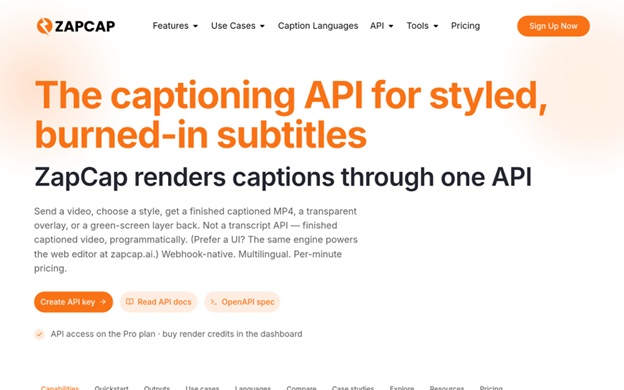
ZapCap is a video caption generator built for developers and creators who need accurate, styled captions at speed. Their platform handles caption generation, B-roll, auto-cuts, and multilingual rendering across 90+ languages and different video formats up to 4K. Developers who need a reliable API for video caption generation will find the platform's frame-accurate timing and flexible output formats (MP4, alpha overlay, or green-screen layer) genuinely useful in production. With 500K+ active users and 700K+ videos created, the adoption numbers are hard to ignore.
Why Does ZapCap Stand Out for Video Caption Generation APIs?
ZapCap solves a real bottleneck for multilingual video teams: producing styled, burned-in subtitles at scale without manually syncing timestamps or managing rendering infrastructure. At $0.10 per minute for rendered video, the pricing is developer-friendly
Summary of Real User Reviews:
Trusted by creators like Ali Abdaal and Vanessa Lau, ZapCap has built strong credibility in the creator economy and agency space. Users consistently point to the speed of caption generation and the multilingual support as standout features. The platform's 176K+ hours of saved production time isn't just a marketing stat. It reflects genuine workflow impact.
-
Creatomate - Best for Video Automation at Scale
What Does Creatomate Do?
Creatomate is a video generation API platform launched in 2020 by a small Netherlands-based team that spotted a real gap in video automation tooling. They built a REST API, a browser-based template editor, and a JavaScript Preview SDK, then layered in no-code integrations via Zapier and Make (covering 5,000+ apps). The platform targets social media content generation, e-commerce personalization, and advertising workflows where video needs to be produced programmatically and consistently at high volume.
Why Does Creatomate Stand Out for Video Caption Generation APIs?
Creatomate bridges the code and no-code divide in a way that most video API platforms don't bother attempting. That dual-lane approach means developers can build deep integrations through the REST API while non-technical teammates run automated workflows without touching a line of code. And that kind of flexibility is genuinely rare in this space.
Summary of Real User Reviews:
Users consistently call out Creatomate's ease of use and responsive customer support as real differentiators. For a two-person team, the product quality holds up well against platforms with much larger operations. Reviewers appreciate the template system and note that the API documentation is clear enough to get up and running quickly.
-
Shotstack - Best for Programmatic Video Generation and API-Driven Automation
What Does Shotstack Do?
Founded in Sydney in 2019, Shotstack is a cloud video editing API that lets developers create, automate, and personalize videos entirely through code. The platform runs on fully managed cloud infrastructure (no rendering servers to maintain), supports JSON-based workflows, and offers a white-label video editor SDK for teams that want to embed video generation inside their own products. Serving 20,000+ businesses across 119 countries, with names like Spotify and IKEA in the customer list, Shotstack has earned real credibility.
Why Does Shotstack Stand Out for Video Caption Generation APIs?
What Shotstack gets right is the API-first architecture: everything is designed to slot into existing developer workflows without friction. The combination of white-label SDK options and proven enterprise adoption means it scales from small developer projects to large-scale production pipelines without requiring a platform change.
Summary of Real User Reviews:
Shotstack earns consistent praise for ease of integration and high-performance rendering. Developers mention that the fully managed infrastructure removes significant operational overhead (think: no surprise server bills mid-project). The $770K bootstrapped revenue figure suggests the product is genuinely retaining paying customers, not just attracting free-tier signups.
-
Bannerbear - Best for Automated Social Media Visuals and Ecommerce Banners
What Does Bannerbear Do?
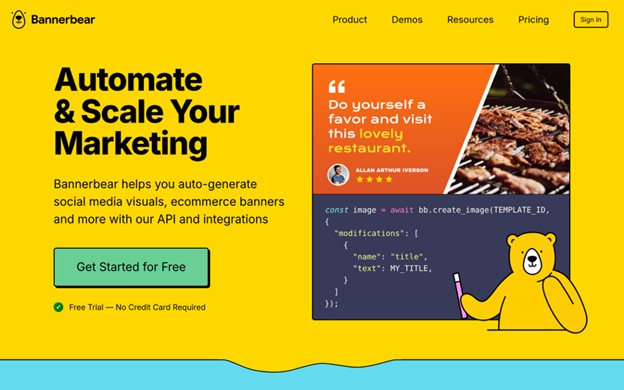
Bannerbear is a Singapore-based API platform focused on the automated generation of social media visuals, ecommerce banners, and marketing content. Founded in 2020 and bootstrapped to nearly $1M in annual revenue (around $991K in 2024), the company has built an API-first tool that connects to Airtable, Zapier, and other workflow platforms so teams can generate visual content at scale without manual production work. It's a tight, focused product that does one thing well rather than trying to cover every video use case.
Why Does Bannerbear Stand Out for Video Caption Generation APIs?
Bannerbear's strength sits at the intersection of API reliability and workflow automation for teams that need repeatable, programmatic visual content generation without heavy dev overhead. Its status as an official Zapier Partner reflects genuine ecosystem trust and third-party integration depth that competitors at the same size rarely match.
Summary of Real User Reviews:
With 596+ customers paying for a bootstrapped product, the market fit is real. Reviewers point to the API simplicity and workflow automation as the main draws. Bannerbear isn't trying to be a full video production platform, and users appreciate that focused scope because it means the primary functionality works reliably without unnecessary overhead.
-
Json2video - Best for Video Automation in E-Commerce, Real Estate, and News Publishing
What Does Json2video Do?
JSON2Video is a Barcelona-based video automation API launched in 2022 that lets developers compose scenes, add captions, create voiceovers, and render final videos inside a single pipeline. The platform supports real HTML5 and CSS elements, built-in animations, and integrations with IFTTT, Make, and Zapier. Their focus on niche industries like real estate showcases, used car listings, and news publishing gives them a specific angle that broader platforms don't cover as cleanly. With 10M+ videos created for 70,000+ users, they've built serious volume for a young, unfunded startup.
Why Does Json2video Stand Out for Video Caption Generation APIs?
JSON2Video's claimed 99.9% API availability and sub-2-minute average render times address two of the most frustrating challenges in caption-heavy video automation: reliability and speed at scale. Winning HackerNoon's Startup of the Year validates the technical depth, but the real signal is 10M+ videos rendered by an unfunded team. That shows the infrastructure actually holds up under load.
Summary of Real User Reviews:
A 4.9 out of 5 rating across verified Capterra reviews is a strong signal, especially given that smaller review sets tend to be more candid than large aggregate scores. Reviewers highlight the all-in-one pipeline approach (captions, voiceover, and render in one flow) as something that saves real back-and-forth between tools. That kind of unified workflow is hard to match without building custom infrastructure.
Research Methodology and Selection Process
Putting together a list of the best video caption generation APIs required more than a quick scan of product pages. The process was structured around sourcing reliable signals from multiple directions before any platform made the final cut.
Initial Data Collection
The longlist was built by pulling platform data from developer-focused directories, software review sites, and technical documentation hubs. Publicly accessible case studies and company profiles were catalogued alongside user-generated reviews from platforms where verified purchasers document real usage. The goal at this stage was breadth: gathering enough raw data to compare platforms across capability, reach, and context before narrowing down.
Shortlisting Phase
Once the longlist was assembled, options without verifiable track records in video API software were removed. Review patterns were analyzed to separate platforms with genuine, recurring user satisfaction from those with sparse or inconsistent feedback. Platforms where the review volume was too low to draw reliable conclusions were flagged but not automatically excluded, since newer entries in this space can still show strong technical quality through other signals.
Verification of Claims
Each platform's stated capabilities were cross-referenced against what actual users reported. When a company claimed high transcription accuracy, fast render times, or broad language support, those claims were checked against reviews, documented use cases, and available performance benchmarks. Discrepancies between marketing language and real-world outcomes were noted and weighted against the platform's overall rating.
Authority and Industry Contribution Layer
Beyond product performance, platforms were evaluated for authority signals: industry awards, mentions in developer publications, original research contributions, and third-party ecosystem recognition. An official Zapier Partner designation, a startup award win, or enterprise customer logos aren't just PR. They reflect genuine external validation from parties that have evaluated the product independently.
Video Caption Generation APIs-Specific Evidence
The final filter is applied to video captioning and caption API use cases. Platforms needed dedicated service or feature pages covering caption generation, verified reviews referencing caption or subtitle functionality, and at least some evidence of real-world captioning deployments. General video tools without clear captioning API documentation or user evidence of captioning workflows were excluded from the final list, keeping the comparison focused on platforms where caption generation is a documented and validated capability.
How to Choose the Right Video Caption Generation APIs
Choosing the right captioning API comes down to matching the platform's actual capabilities to your specific production environment. The range across these five options is wide, so the right fit depends on which factors matter most for your workflow.
- Industry/Domain Experience: Look for platforms with verifiable track records in video captioning. Broad video generation tools and dedicated captioning APIs serve different needs.
- Features and Capabilities: Check whether the platform supports burned-in subtitles, multilingual rendering, timestamp accuracy, and the output formats your pipeline requires.
- Pricing Structure: Understand the cost per audio minute processed and whether the pricing model scales predictably at higher API call volumes.
- Results Measurement: Confirm the platform provides measurable outputs like WER scores, caption synchronization accuracy, or processing speed benchmarks so you can track quality over time.
- Industry Knowledge and Compliance: For platforms serving public-facing content, verify that the API supports WCAG 2.1, ADA Section 508, and FCC Part 79 captioning standards out of the box.
Bottom Line
The best video caption generation API depends entirely on your use case. ZapCap suits multilingual creators and agencies. Shotstack fits enterprise-scale programmatic production. Creatomate and Bannerbear serve automation-heavy workflows. JSON2Video covers niche verticals well. As demand for accessible, multilingual video content keeps growing, the gap between platforms built for captioning and those that treat it as an add-on feature will only get more obvious.