Operations | Monitoring | ITSM | DevOps | Cloud

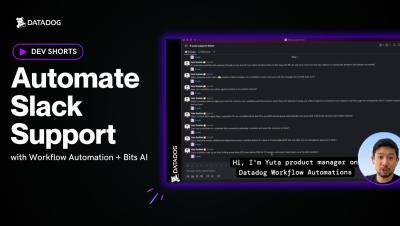
Automate Slack Support with Datadog Workflow Automation + Bits AI

Automate Slack support questions with Datadog Workflow Automation and Bits AI Agent Builder. Datadog Workflow Automation can now trigger directly from messages posted in Slack. In this quick demo, Yuta Yoshida, Product Manager at Datadog, shows how to build an automated support workflow that: → Detects new support questions in a Slack channel→ Sends questions to a custom agent built with Bits AI Agent Builder→ Replies directly in the Slack thread with an answer and relevant documentation.
Modal scales the next generation of AI with unified observability from Datadog

Modal is an AI infrastructure company rebuilding the cloud for AI, giving developers easy access to the compute needed to build and scale AI applications without managing the underlying complexity. Operating across more than 20 cloud providers and launching approximately 26 million containers daily, Modal relies on Datadog to unify observability across its infrastructure, applications, networking, and CI—helping its engineers detect 99% of incidents within five minutes, resolve 96% of issues before customer impact, and confidently scale one of the world’s most complex AI platforms.

Accelerating Resolution with Autonomous Incident Response v1

Incident response often spans a patchwork of tools, handoffs, and manual steps. An engineer gets paged, a team investigates the issue, the incident commander coordinates the response, SREs document decisions, and somebody (anybody!) writes the postmortem. Every handoff introduces more context switching, increasing the risk of critical information loss, and ultimately slowing resolution.

Building an AI Assistant That Actually Understands Your Incidents

When production breaks, the clues are everywhere but the story is scattered. RUM sessions, APM traces, metrics, and logs allow Datadog to tell you part of the story. What’s missing is your service ownership quirks, your team's conventions, or the three-year-old workaround buried in a comment that explains why a certain endpoint behaves the way it does.

Democratizing Incident Response with AI at Riot Games - SRE Track

Senior engineers are the pillars of SRE programs—not only do they have the leadership to manage incidents well, they also have the tribal knowledge to understand the technical causes of tricky issues. But when the know-how is confined to a few individuals, it greatly limits the effectiveness of your SRE team.

How Do You Review 10x the Code? You Don't - Developer Track

AI is generating code at 10x human speed, but we’re not shipping software 10x faster. Agents have a quality problem, and we still can’t trust their output without validation. Breaking the code review model didn’t help. So what would it take to autonomously ship code that’s actually trustworthy? Join us to explore what an agentic harness looks like when the SDLC is the harness, a validation system that spans intent, CI, staging, and production, with context flowing bidirectionally between all stages.

Datadog San Francisco Summit: Keynote

Datadog has always been driven by a broader vision of helping teams understand and operate complex systems. In this session, you'll hear from Michael Whetten, Senior Vice President of Product Management, and Cansu Berkem, Director of Product Management, as they share the latest updates across the Datadog product suite and discuss how that vision continues to shape the platform's evolution and support the next generation of AI-driven applications.

Dismantling Datadog's Monolith with Agentic AI - Developer Track

AI can write code, but how does it do with a large, organically built codebase with years of development? Datadog’s monolithic webapp had significant scale and support challenges, so we knew the time had come to break it up. But when the code has been written, revised and tweaked so many times (as we keep adding new features and capabilities), by so many teams, that becomes much harder.