
4 Best Organizations Helping People Clear Criminal Records & Expunge Your Past

Second chances are rare. In Michigan, only 6.5 percent of people eligible for expungement secure relief within five years - leaving millions stuck behind background-check barriers because help is scattered across policy advocates, civic-tech pilots, and local legal-aid clinics.
We wrote this guide to change that. You’ll see four leading 2026 organizations side by side, so you can tell who they serve, where they operate, and what it costs. This is legal information, not personal advice; always confirm your state’s rules before you act.
How we chose the best organizations helping people clear criminal records
Evidence beats marketing. We relied on published data, not taglines, to decide who made the list. The Access to Justice Lab’s randomized trial in Kansas shows why rigor matters: participants represented by Kansas Legal Services cleared records at an 82 percent rate, against 8 percent for those given self-help materials alone (a2jlab.org).
We then scored each candidate on six pillars (100-point scale):
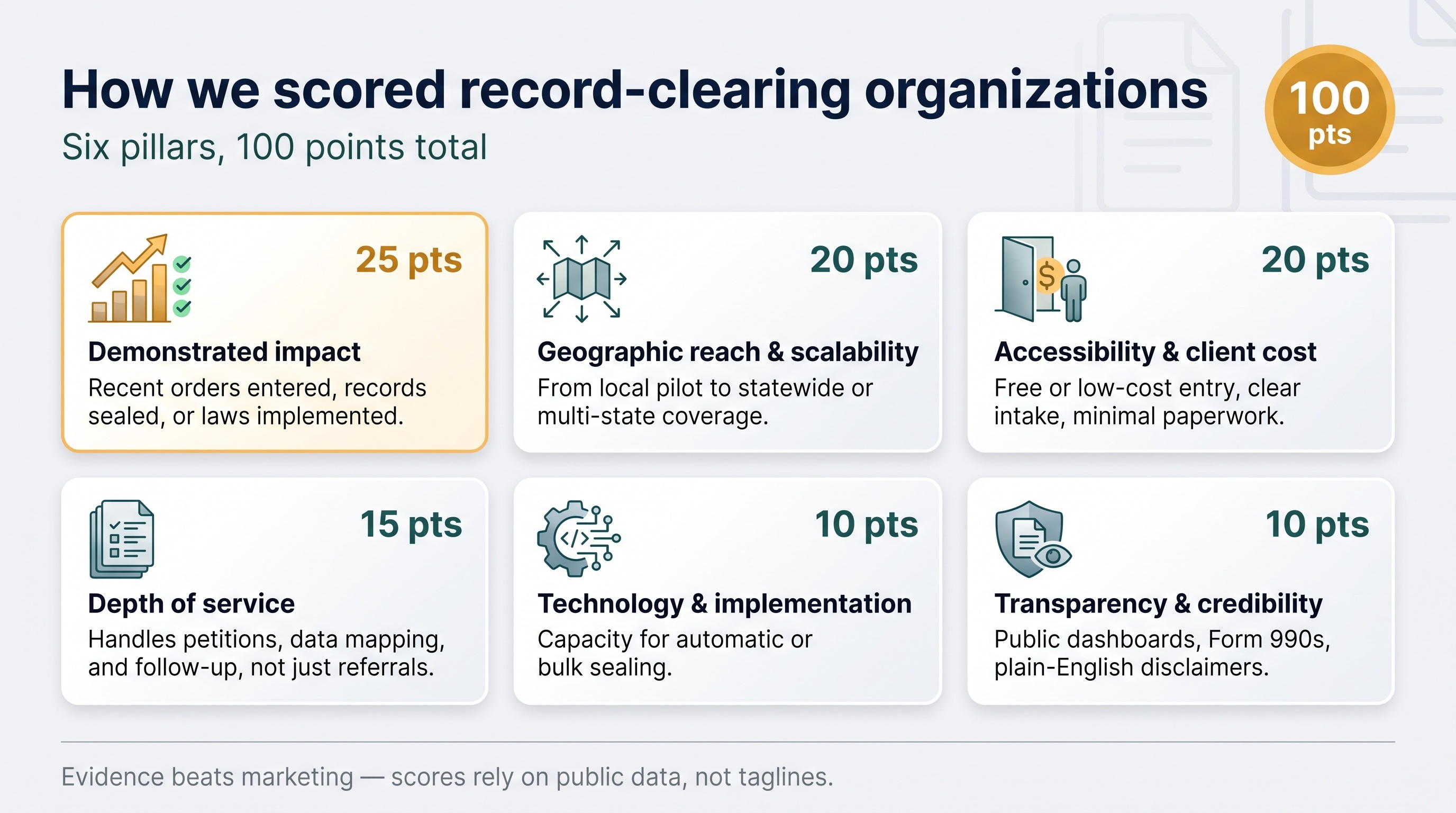
- Demonstrated impact (25 pts): recent orders entered, records sealed, or laws implemented
- Geographic reach & scalability (20 pts): local pilot versus statewide or multi-state coverage
- Accessibility & client cost (20 pts): free or low-cost entry, clear intake, minimal paperwork
- Depth of service (15 pts): handles petitions, data mapping, and follow-up, not just referrals
- Technology & implementation know-how (10 pts): capacity for automatic or bulk sealing
- Transparency & credibility (10 pts): public dashboards, Form 990s, and plain-English disclaimers
The four organizations that follow earned the highest combined scores.
How to read this list without getting lost in the numbers
Each organization measures impact a little differently. Keep these yardsticks straight so you compare like with like:
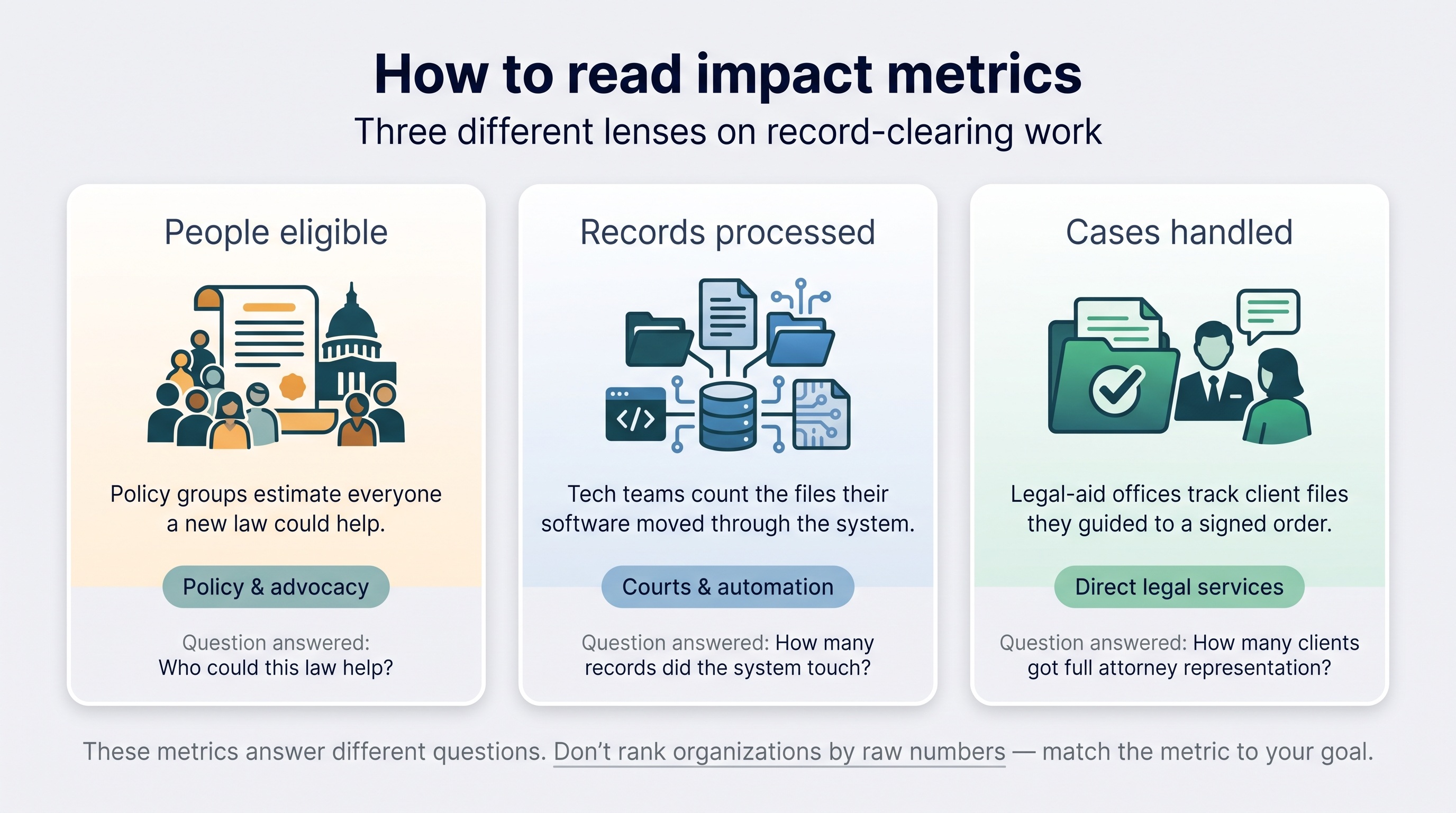
- People eligible: policy groups estimate everyone a new law could help.
- Records processed: tech teams count the files their software moved through the system.
- Cases handled: legal-aid offices track client files they guided from intake to signed order.
Those metrics answer different questions, so we left the list unranked. A statewide attorney who files your petition solves a different puzzle than a coalition that automates sealing for millions. Match the metric, and the model, to the problem you want solved.
1. The Clean Slate Initiative: best for national policy and automatic sealing
CSI’s campaign hub brands this push the “Race to 14,” and its regularly updated Clean Slate state campaigns page shows which bills cleared committee, passed chambers, or just earned a governor’s signature.
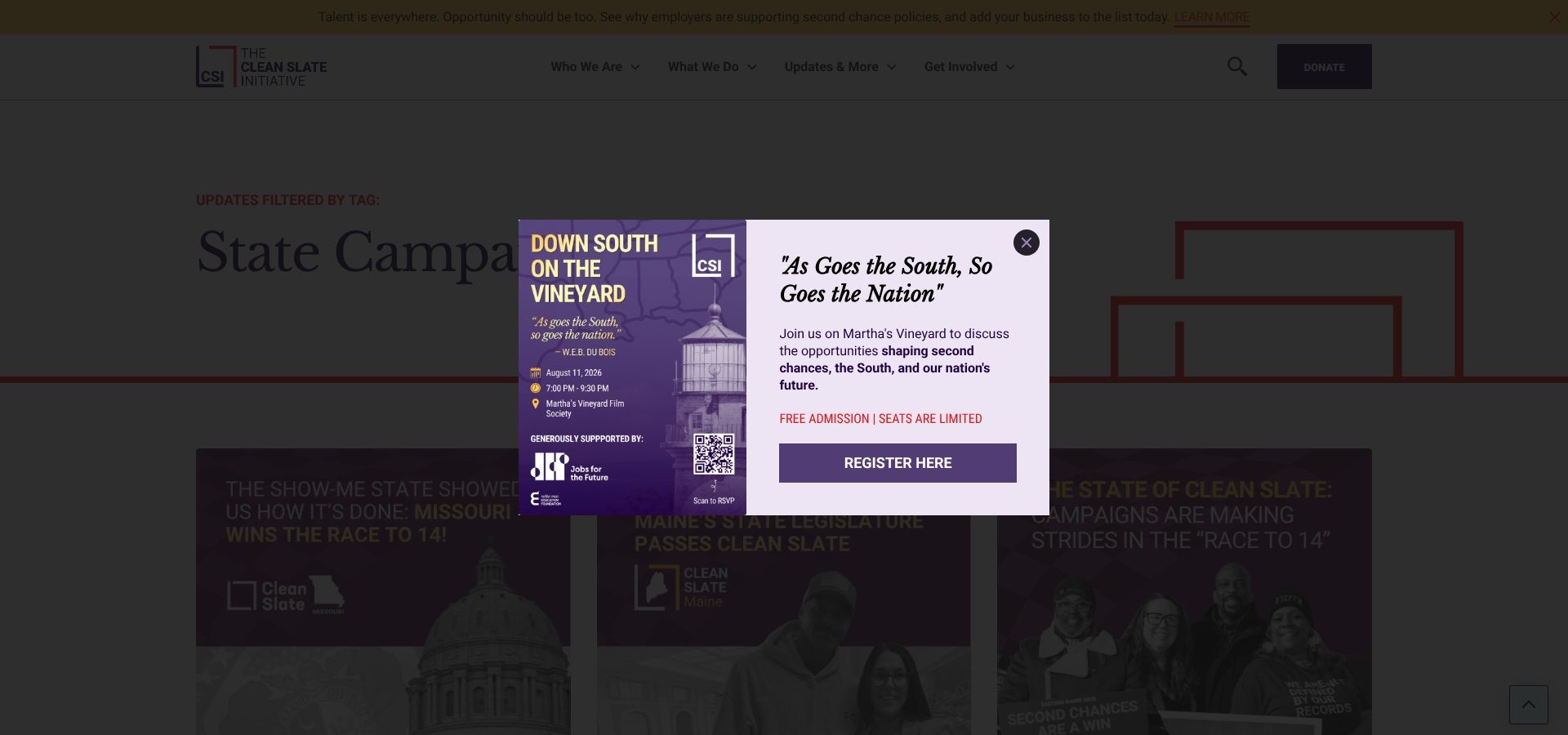
Clean Slate Initiative state campaigns page screenshot for automatic sealing laws.
Why it matters
The Clean Slate Initiative (CSI) is a 501(c)(3) launched as a national campaign in 2020, from a Clean Slate campaign begun in 2018, to pass and implement laws that automatically seal eligible criminal records. As of July 2026, CSI reports that more than 18 million adults are on a path to full or partial automatic sealing in 14 states and Washington, D.C. (cleanslateinitiative.org).
What CSI does
- Drafts and advocates bipartisan automatic-sealing bills
- Stays after passage to translate eligibility rules into machine-readable code and guide courts through bulk sealing
- Funds local partners for community outreach and progress monitoring
- Publishes dashboards and research so lawmakers can track implementation
What CSI doesn’t do
CSI is not a law firm or clinic. It changes the rules so most people never need to file a petition, but it cannot take individual cases.
Where it works
Clean Slate laws meeting CSI criteria are active in 14 states plus D.C.; rollout dates vary. For instance, parts of Illinois’ Clean Slate Act took effect on June 1, 2026, but the automation itself is still being built. State agencies have until 2029 to develop and test it, the Illinois State Police must seal the first group of records by January 1, 2030, and automated sealing by the Circuit Courts begins by January 1, 2031. An Illinois reader who needs relief before 2030 should treat the petition route as the live option. Check your state judiciary or criminal-history repository for the exact timeline. If your record sits outside a Clean Slate jurisdiction, or you need help now, move to the direct legal-aid sections.
2. Code for America / Clear My Record: best for government-scale automation
Why it matters
Code for America (CfA), a San Francisco-based 501(c)(3) founded in 2009, builds software that helps courts automatically identify and clear eligible convictions. In California, the platform let district attorneys in a five-county pilot recommend relief on more than 85,000 Proposition 64 convictions, nearly 66,000 of them in Los Angeles County alone, and Code for America then offered the tool free to all 58 counties.
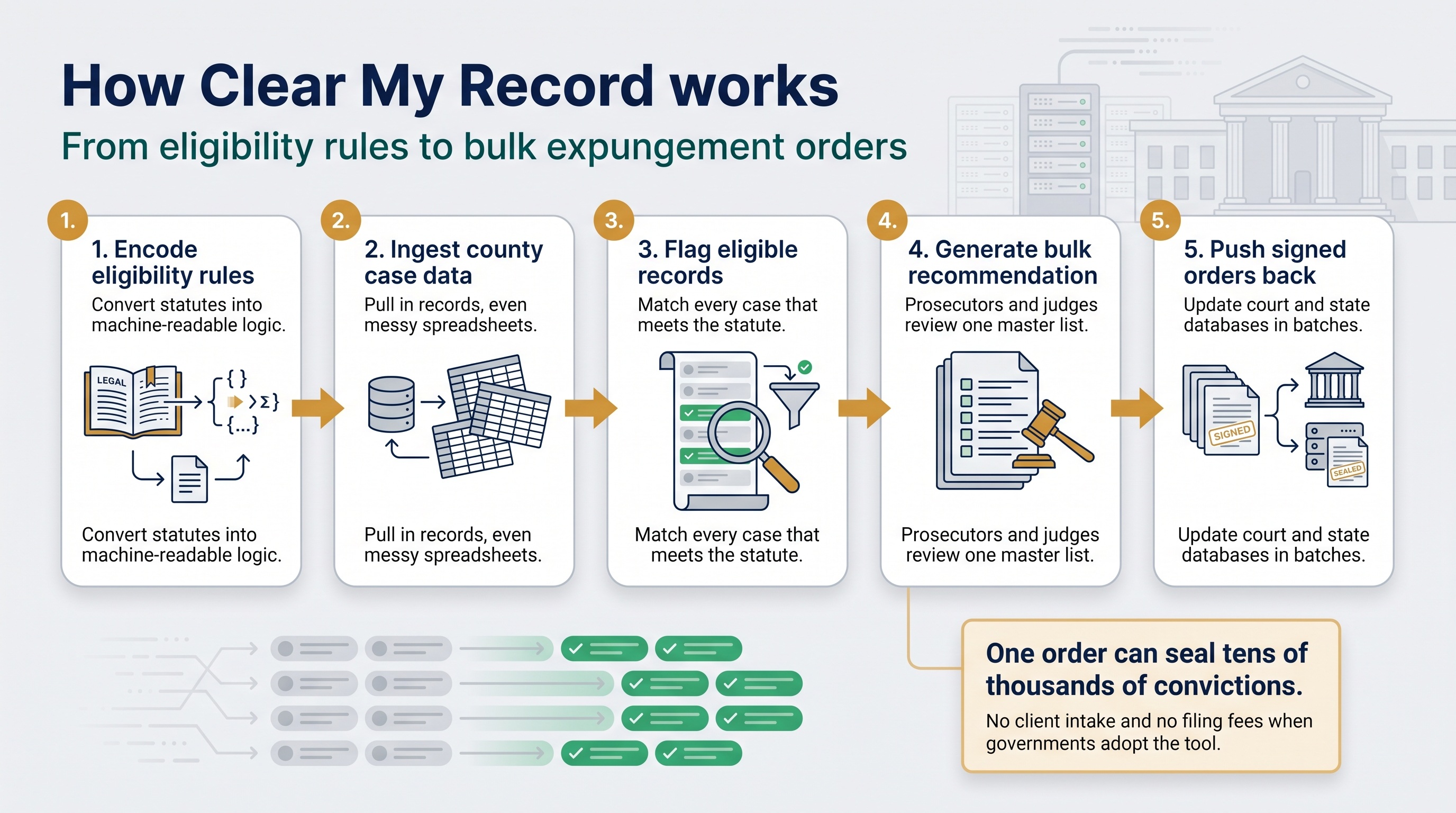
How Clear My Record works
- Translate eligibility rules into machine-readable code.
- Ingest county case data, even messy spreadsheets.
- Flag every record that meets the statute.
- Generate one bulk recommendation; prosecutors and judges review it.
- Push signed orders back to the court and state repositories.
One order can seal tens of thousands of convictions, with no client intake and no filing fees.
Where it’s live
- California: statewide cannabis and selected felony relief
- Utah: statewide Clean Slate automation
- Minnesota and pilot counties in two additional states: eligibility-analysis pilots (July 2026)
If your county is not on that list, the software cannot help yet. Always confirm with your local court before assuming relief is automatic.
What CfA is (and isn’t)
CfA supplies the technology and implementation playbook. It does not represent individuals; you will not find a client intake form on its site. When governments adopt the tool, residents benefit automatically. Otherwise, you will need a petition-based legal-aid option.
3. Community Legal Services of Philadelphia: best direct service and policy hybrid
Why it matters
Since 1966, Community Legal Services (CLS) has provided free civil representation to low-income Philadelphians. Its criminal-record unit handles more than a thousand criminal-record cases a year, while the same attorneys helped draft the state’s landmark Clean Slate law.
What CLS does
- Direct representation: staff attorneys pull state RAP sheets and municipal dockets, flag eligible charges, draft petitions, and appear in court.
- Policy advocacy: CLS supplies data and testimony that shaped Pennsylvania’s automatic-sealing statute, then monitors implementation glitches that surface in client files.
- Post-order follow-up: lawyers track whether sealed cases disappear from state police records and private background reports.
Client journey
- Intake: applicants must live or work in Philadelphia and generally earn below 200 percent of the federal poverty level (2026 guideline).
- Record review: staff request your RAP sheet and any local dockets that never synced to the state database.
- Petition and hearing: attorneys draft petitions, update fingerprints if needed, and argue objections before the judge.
- Verification: after an order signs, CLS confirms updates in court portals, state police files, and consumer-reporting databases. You leave with written proof and a checklist for future background disputes.
All legal services are free, and most court fees are waived. Typical petition cases resolve in four to nine months, but complex multi-case files can take longer, especially when prosecutors request additional review.
If you are outside Philadelphia or over the income cap, move to statewide options.
4. Legal Aid of North Carolina: best statewide direct legal-aid model
Why it matters
Legal Aid of North Carolina (LANC) runs offices across the state and covers all 100 counties, handling criminal-record expunctions everywhere from Asheville to the Outer Banks and giving residents free legal help that few local clinics can match.
What LANC does
- Screens criminal records for statutory eligibility
- Drafts and files petitions in multiple counties when needed
- Represents clients at hearings and confirms that sealed cases vanish from state and private databases
Cost and eligibility
Representation is free for clients who earn up to 125-200 percent of the federal poverty level (guideline varies by grant). Court filing fees are usually waived; staff alert you to any costs before filing.
What to expect
Most straightforward petitions resolve in six to 12 months, depending on county court schedules. Multi-county files or prosecutor objections can take longer.
If you live in North Carolina and need record relief, start with LANC’s central intake line or the online application; the team already knows each county clerk by name.
Which organization is right for you?
Match your situation to the model that fits:
- I need a lawyer now.
- Philadelphia cases → Community Legal Services
- Any North Carolina county → Legal Aid of North Carolina
- My state passed a Clean Slate law, and I’m waiting on automation.
Check your rollout date on the Clean Slate Initiative list; automatic sealing may take months or even years to finish. - I work for a court, prosecutor, or IT agency dealing with a backlog of old records.
Bring in Code for America’s Clear My Record team to translate eligibility rules into software and batch-seal cases. - None of the above applies.
Search your state bar’s pro bono panel or a Legal Services Corporation grantee; petition relief is slower but still effective.
Use this map and you will spend energy on the right door instead of a dead end.
How the criminal-record-clearing process usually works
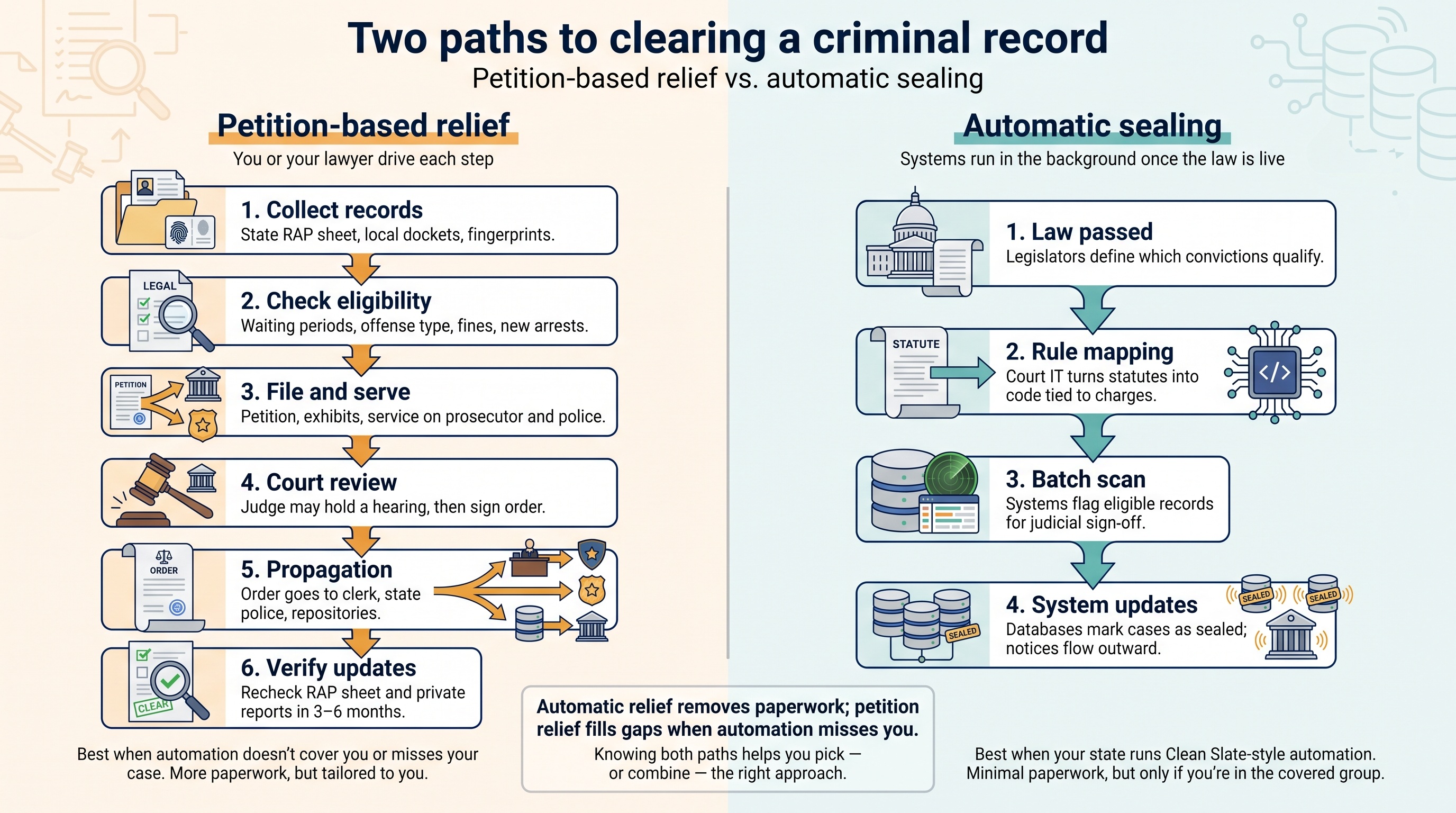
Petition-based relief
- Collect records. You or your lawyer pull the state RAP sheet, local dockets, and any fingerprint cards.
- Check eligibility. Statutes screen for waiting periods, offense type, unpaid fines, and new arrests. Miss one requirement and the petition stalls.
- File and serve. Draft the petition, attach exhibits, and send copies to the prosecutor, police, and, if required, the attorney general.
- Court review. The judge may hold a hearing; if criteria are met, an expungement order is signed.
- Propagation. The order goes to the clerk, state police, and any other repository.
- Verify updates. Re-pull your RAP sheet and dispute private background reports 3-6 months later; some agencies update quarterly.
When everything aligns, relief can arrive in three to 12 months. Complex cases or crowded dockets can stretch the timeline further.
Automatic sealing
- Law passed. Legislators define which convictions qualify.
- Rule mapping. Court IT teams translate statutes into code tied to offense numbers.
- Batch scan. An overnight job flags eligible records and routes them for judicial sign-off.
- System updates. Approved records are marked “sealed” in court and state databases; notices flow to licensing and background-check repositories.
Automation is not perfect. A 2026 study of 105 eligible people found that failures to notify, partial clearances, and opaque data flows created new burdens (Law & Society Review, May 2026). Still, when databases sync properly, one automated run can seal tens of thousands of records with no petitions or filing fees.
Automatic relief removes paperwork; petition relief fills gaps when automation misses you. Knowing both paths lets you choose the right approach or combine them.
Typical timeline variables
State procedures differ, but six checkpoints often slow expungement and sealing:
|
Step |
Why it matters |
Typical delay* |
|
Record retrieval |
State and local databases may not match; clerks must reconcile errors |
2-6 weeks |
|
Legal-aid intake |
High demand can push first appointments to the next quarterly docket |
1-3 months |
|
Prosecutor review |
Some offices approve on filing; others route to supervisors |
2-8 weeks |
|
Court scheduling |
Expungement hearings compete with trials and motions |
4-12 weeks |
|
Repository updates |
State police and FBI post orders in batch cycles, often quarterly |
4-16 weeks |
|
Private background refresh |
Consumer-reporting agencies buy data on varied cycles |
1 week to 12 months |
*Ranges are typical rather than published figures; local timelines vary widely.
Stacked end to end, a straightforward case can finish in about three months, while multi-county files can approach two years. Build follow-up reminders, especially a background-check audit, into your personal timeline so the last mile does not undo earlier wins.
The last mile: confirm your record is really gone
Follow these four checks and set two reminders:
- Get certified proof. Ask the clerk for a certified copy of the sealing or expungement order and store it safely; you will need it if a background screener reports outdated data.
- Pull a fresh RAP sheet. Most state police agencies will send an updated criminal-history report for a small fee or fee waiver. Compare it with your pre-expungement copy; the sealed case should be absent or marked “sealed.”
- Search the court portal. Enter your name or case number. Some portals erase the docket; others display a shell marked “SEALED.” Capture screenshots as evidence.
- Dispute private reports. Under the Fair Credit Reporting Act, consumer-reporting agencies must correct errors within 30 days of receiving your dispute and supporting documents (15 U.S.C. § 1681i). Include the certified order and keep copies of every letter.
Set reminders
- 90 days after the order: repeat steps 2-4; state and FBI repositories often update quarterly.
- 6 months after the order: run the same audit again; many background-screening firms buy bulk data only once or twice a year.
Verification is part of the job, not an optional extra. Keep proof handy and schedule these calendar checks so your clean slate stays clean.
How to vet an expungement organization or service
Run these five checks before you share a single document:
|
Checkpoint |
What to look for |
Where to verify |
|
Legal structure |
501(c)(3) EIN, government URL, or law-firm registration |
IRS Tax-Exempt Search; state bar directory |
|
Attorney oversight |
Named lawyers and bar numbers on the site |
State bar “attorney search” page |
|
Jurisdiction clarity |
Precise list of states or counties served, not vague “nationwide” claims |
Service map or engagement letter |
|
Transparent pricing |
Posted fee schedule or statement of free services; court costs disclosed up front |
FAQ or engagement agreement |
|
Privacy policy |
Encryption, data-sharing limits, opt-out options for media or marketing use |
Site footer → “Privacy” link |
How to find help if none of the four serves your state
Shortcut to reliable resources:
- Legal Services Corporation locator: enter your ZIP code at lsc.gov/find-legal-aid to see the nearest federally funded civil-legal office; many host expungement clinics even if not advertised.
- State-bar pro bono panels: search "pro bono" plus your state bar; volunteer lawyers often waive filing fees for qualified clients.
- NACDL Expungement Service Map: visit nacdl.org/Map/ExpungementServicesMap for statewide clinic dates and DIY forms.
- Health-focused directories: the Center for HIV Law & Policy’s record-clearing guide (hivlawandpolicy.org/resources) lists low-cost options in every state, not just for health clients.
- Court self-help portals: states such as Utah, Michigan, and California publish interactive quizzes and printable petitions on their judiciary websites.
Mix and match these sources to build a backup plan that fits your ZIP code, budget, and timeline.
Emerging record-clearing tech to watch
ClearPath TX: end-to-end e-filing (launched June 2026)
ClearPath TX aims to combine eligibility screening, petition generation, e-filing, and legal-aid referral on one web platform. In its June 2026 debut, a coalition of Texas legal-aid organizations announced a multi-phase project to build this unified system, starting with coordinated statewide expunction clinics.
Key planned features
- Streamlined platform that guides users from eligibility screening through case resolution
- System to assess eligibility and generate legal documents
- Support for e-filing plus referrals to legal assistance when needed
Later phases are planned but no statewide rollout date has been published. If the build lands as designed, Texas could shift from paper-heavy petitions to mostly online filings without extra courthouse staff.
Post-order clearinghouses: fixing private reports
Private background reports routinely lag the courts. Research on state-level criminal record data quality has documented how incomplete and unresolved records follow people through commercial screening (David McElhattan, “Punitive ambiguity,” Punishment & Society, 2021). Clearinghouses such as the Foundation for Continuing Justice’s Expungement Clearinghouse tackle that gap:
- Maintain a master list of sealed or expunged docket numbers
- Push updates to more than 500 private-sector background-data sources, typically within 90 to 120 days
- Cut down individual dispute letters and lower employers’ FCRA liability
For applicants, this means fewer update requests and one correction that travels further than a stack of individual dispute letters. For employers, it reduces lawsuits over outdated data.
Keep an eye on these tools; they target the two places expungements most often stall: filing and follow-through.
Does clearing a record boost jobs or public safety? The evidence so far
|
Study |
Sample and design |
Key findings |
Follow-up effects |
|
Michigan administrative study (2020) |
Statewide administrative records on expungement-eligible people; observational |
6.5 percent obtained relief within five years; wages rose 22 percent in the year after sealing; no increase in re-arrest |
Outcomes are correlations, not causal proof |
|
Kansas randomized trial (Greiner, Stubenberg & Danser, North Dakota Law Review, 2025) |
Applicants randomized to representation by Kansas Legal Services versus self-help materials |
82 percent with lawyers obtained orders versus 8 percent with self-help |
The lab tracks subjects for years after the order, so long-run employment and housing effects are still coming in |
|
Clean Slate Initiative tally (2026) |
Legislative tracking across 14 states plus D.C. |
18 million adults on a path to automatic sealing |
Bottleneck shifts to IT implementation and notification |
Takeaway: Expungement removes a legal barrier, but bigger gains depend on timing (sooner beats later), local labor markets, and whether every background database refreshes. Clearing the record is necessary infrastructure, and it works best when paired with fair-chance hiring, reentry services, and rigorous data cleanup.