Operations | Monitoring | ITSM | DevOps | Cloud

A practical guide to standardizing app delivery without rebuilding everything internally

Standardize the route from code to production. Everything else is a team decision, not a platform problem. Most app delivery problems do not start with bad engineering. They start with too much variation. One team provisions environments manually. Another keeps deployment notes in a wiki. A third has a staging setup that only one engineer understands. Security reviews happen late because the platform does not make the safe path obvious.
MTTR - Mean Time to Repair: Definition and the Hidden Costs of Downtime

When a critical system goes down, the clock starts ticking. Every minute matters. Whether it’s a cloud platform, manufacturing operation, logistics center, airport infrastructure, or business-critical software, downtime creates more than just technical issues — it often leads to significant financial losses. That’s where MTTR comes in. MTTR measures how long it takes an organization, on average, to restore normal operations after an incident.

Top 10 Prompts for Your Monitoring Tool

You open a monitoring tool, and the data is all there: errors, traces, anomalies, incidents, and countless intricacies. If you want to get the right slice of that data, you need to know exactly which dashboard to open and what filters to apply. But when the poor UI gets in the way, this can take longer than it should. Luckily, this is not the case with AppSignal. MCP (Model Context Protocol) changes the interface entirely.

Three Years a Leader. Thank You.

Dear Nexthink community, We are excited to be named a Leader in the 2026 Gartner Magic Quadrant for Digital Employee Experience Tools for the third year in a row. I want to share this recognition with our customers, our partners and ecosystem, and every Nexthinker across the world. As a founder, it’s a true honor to work alongside so many talented people. To us, this recognition is also yours.

Beneath the Stack: A Software Engineer's Journey into Infrastructure

A software engineer's hands-on journey building a private cloud on bare-metal: Incus clustering, K3s, OVN networking, the Gateway API, and everything that breaks along the way — and what it taught them about why platforms like Qovery exist. Antoine is a senior software engineer at Qovery. He writes about hands-on infrastructure engineering, Kubernetes internals, and the realities of running production systems.

Shipped: Counting tokens isn't enough. Start connecting them to outcomes.

You’re funding AI across four billing relationships – Anthropic direct, OpenAI, Claude through Bedrock, Claude through Vertex – and the spend climbs every month. When your CEO asks what it’s producing, you have a number and no answer. Not which product it built, which customer it served, or which bet it’s paying off. And you’re being asked to approve more of it.

It Can Only Goodhart Happen

When a measure becomes a target, it ceases to be a good measure. Charles Goodhart, 1975 You’ve probably read this quote in relation to any number of things over the years. People complaining about arbitrary metrics like PRs merged, lines of code produced, and now, token usage. But is the era of tokenmaxxing over before it even began? The rise of token leaderboards to the death of token leaderboards at companies like Amazon seem to have taken place in less than three months!

Certificate lineage: the concept your tools already use but nobody named

The word “certificate” means too many different things. When someone says “the certificate for example.com,” they might mean the public key the CA signed. They might mean the key-pair sitting on the filesystem. They might mean the signature that expires in 47 days. Or they might mean all the things together, that you’ve been renewing for the last 10 years. That last one doesn’t have a name in any PKI standard. And it should.

What is SRE Observability and Key Pillars You Should Know?

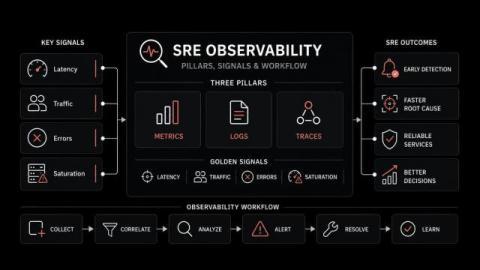
What happens when a critical service slows down, but nothing is technically “broken”? Most teams have monitoring in place. They know when something goes down. But when performance drops or issues spread across services, finding the real cause becomes slow and unclear. Engineering teams end up switching between dashboards, logs, and alerts just to understand what changed. This delays response and increases pressure on on-call teams. This is where SRE observability becomes essential.