Operations | Monitoring | ITSM | DevOps | Cloud

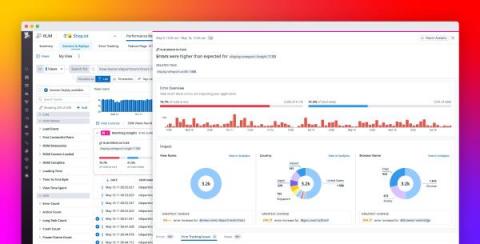
Automatically identify and efficiently investigate frontend issues with RUM Watchdog Insights

When your applications are experiencing degraded frontend performance, every minute of investigation counts towards minimizing the impact of regressions on your users. That’s why we built Watchdog Insights, an AI-powered recommendations engine that augments monitoring investigations by intelligently surfacing data that sheds light on outliers in the errors and latency affecting your applications.


The Power of Peer-To-Peer Networks and the Rise and Fall of Limewire

What if you could share anything to anyone online freely, with no middle man? Imagine a place where information flows freely and connectivity is ubiquitous. Enter peer-to-peer (P2P) networks and they are (or were) a game-changer. These decentralized networks have revolutionized the way we share files, enabling users to connect directly with one another without the need for a central server. And yes, you’ve heard about them before. One of the most prominent pioneers of P2P file sharing was Limewire.

Did Your Datadog Bill Explode?

Custom metrics is a key component for many companies. Stock available in warehouses, shopping cart status, number of products sold, and operational status for industrial machines are some of the many KPIs that companies need for their own business tracking purposes. When it comes to custom metrics and observability platforms costs, many companies are struggling to find a good balance between availability, performance, reliability, and costs.

Zephyr Deep Dive: Ring Buffers

Zephyr includes many built-in features like stacks for networking and BLE, Flash storage APIs, and many kernel services. These components allow you to quickly get up and running with a project and maintain less code! Taking advantage of these is a huge win for small firmware teams and was a huge motivation in bringing Zephyr to my teams. This post covers Zephyr’s built-in ring buffer API, a component commonly used in producer-consumer scenarios.

A guide to static application security testing (SAST)

Static application security testing (SAST) involves analyzing source code to identify and address potential security vulnerabilities. Using SAST early in development identifies threats before they can affect a live environment. SAST is particularly important for continuous integration and continuous deployment (CI/CD) pipelines. These pipelines automate the integration of new code changes into the main codebase and deploy applications to production environments.

How To Diagnose Wireless Network Issues Like a Pro - Check These 4 Things First

When a user’s Wi-Fi network experience falters, frustration often ensues, and the blame is swiftly directed at the wireless network itself. Often, the culprit lies elsewhere. In this blog post, I’ll explore the often overlooked factors that can impact a device’s experience—namely, DHCP, DNS, RADIUS, and improper network segmentation, and how wireless network monitoring can help you solve the issue quickly.