Operations | Monitoring | ITSM | DevOps | Cloud

The Cognitive Ceiling: Why Modern Environments Outgrew Human Interpretation

For more than a decade, organizations invested in tools and telemetry with the belief that more visibility would create more control. Monitoring expanded across cloud, application, network, and infrastructure layers. Observability platforms entered the mainstream. Automation tools promised faster detection and improved coordination. Yet despite these advancements, incidents are not easier to understand. War rooms still fill with conflicting interpretations. Signals generate more questions than answers.

Unifying Telemetry in Battery Energy Storage Systems

Battery energy storage systems (BESS) play a critical role in modern energy infrastructure. Utilities rely on these systems to balance renewable generation, stabilize grid operations, and respond to changing electricity demand. As deployments scale in size and complexity, operators require continuous insight into battery health, system performance, and grid interaction. Operators rely on telemetry generated across several operational platforms.

Bridging the Gaps in Modern Operations: How Real-Time Messaging Improves System Reliability

In modern IT environments, reliability is no longer defined solely by system uptime or infrastructure resilience. It is equally shaped by how effectively systems, teams, and processes communicate under pressure. As architectures become more distributed and operations more complex, the gaps between tools, teams, and data streams have become one of the most persistent challenges in maintaining consistent performance.

Product Update - March 2026

IncidentHub's latest product updates focus on improving the public status page, adding integrations with ticketing systems, private status page ingestion, and making the notifications more useful to the end user. Some of these improvements are driven by user feedback. Feedback is what makes the product better, and I am personally grateful to all our customers who have shared their feedback with us.

Monitor schema health with engine.schema_fields: Structure, Drift, and Volatility

If you’ve worked with an observability pipeline, you’ve probably experienced schema problems: a field disappears, a type shifts from string to number, or a new label quietly appears. The causes are everywhere. Different teams adopt different naming conventions. A dependency upgrade changes the shape of a library’s log output. Over time, these small, reasonable decisions compound into schema sprawl: dashboards break, alerts misfire, and teams scramble to find out what happened.

Open standards in 2026: The backbone of modern observability

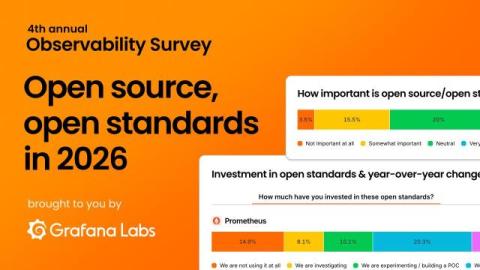
Open source software and open standards are now an essential part of how organizations maintain their systems. That's not to say they haven't always been important, but the fourth annual Observability Survey, brought to you by Grafana Labs, shows just how deeply the shift to open has taken hold, with 77% of respondents saying open source and open standards are important1 to their observability strategy.

AI in observability in 2026: Huge potential, lingering concerns

The role of AI in observability is evolving rapidly, but the data from our fourth annual Observability Survey makes one thing abundantly clear: the potential is real, and so are the reservations. Practitioners overwhelmingly see value in using AI to help surface anomalies, forecast and spot trends, assist with root cause analysis, and get new users up to speed quicker.

How to design cloud environments for AI-powered threat analysis

Cloud environments generate high volumes of security signals every day. With each one, you have to determine if it’s benign, a clear false positive, or something worth investigating. The challenge is needing to make these calls continuously, often without knowing whether any single event is part of a larger attack. Spending too much time investigating benign activity reduces the ability to detect threats elsewhere, and missing a legitimate threat has clear consequences.

Scaling Kubernetes workloads on custom metrics

The 2025 State of Containers and Serverless report found that 64% of organizations use the Kubernetes Horizontal Pod Autoscaler (HPA) to manage Kubernetes workload capacity. But only 20% of those deployments scale on custom metrics. The other four-fifths of organizations rely on resource metrics—CPU and memory utilized by their pods—to trigger autoscaling activity.

AppSignal's MCP Server: Connect AI Agents to Your Monitoring Data

Your AI coding assistant already knows your codebase. Now it can know your production environment too. AppSignal's MCP server gives AI agents and AI code editors direct access to your monitoring data — errors, performance metrics, and more — so they can help you debug, investigate and resolve issues without switching context. And with our new public endpoint, getting started is simpler than ever.