Operations | Monitoring | ITSM | DevOps | Cloud

Top Root Cause Analysis Tools Built for Runtime Context

Root cause analysis tools are designed to help engineering teams understand why failures happen in production and other remote environments. As modern systems become more distributed and input-dependent, many incidents cannot be reproduced outside live environments. The stakes are significant: high-impact IT outages cost organizations a median of $2 million per hour, with annual downtime costs reaching $76 million per organization.

How a Runtime Aware AI SRE Agent Transforms System Reliability

A runtime aware AI SRE extends existing AI SRE approaches by moving beyond telemetry correlation into runtime-validated reliability. While the majority of AI SRE tools accelerate incident triage using logs, metrics, and traces, they cannot confirm execution behavior if critical runtime signals were never captured. By generating on-demand evidence inside running services, AI SRES can eliminate slow redeploy cycles, ensuring your distributed systems remain resilient under real-world traffic conditions.

The Role of Employee Monitoring in Securing Remote Teams: A Comprehensive Guide

How secure is your organisation when employees work from anywhere? Remote work has transformed how modern teams collaborate. They offer flexibility, broader talent pools, and improved productivity. Still, it has also introduced new cybersecurity challenges. 92% of IT professionals believe remote work has increased cybersecurity threats, even as organisations struggle to secure remote access points, home networks, and personal devices.

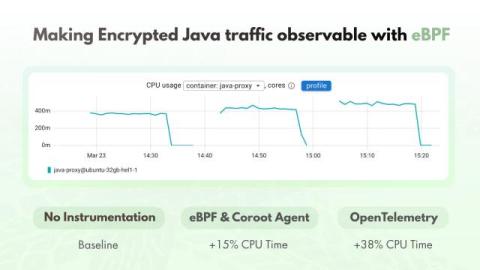
Making encrypted Java traffic observable with eBPF

Coroot's node agent uses eBPF to capture network traffic at the kernel level. It hooks into syscalls like read and write, reads the first bytes of each payload, and detects the protocol: HTTP, MySQL, PostgreSQL, Redis, Kafka, and others. This works for any language and any framework without touching application code. For encrypted traffic, we attach eBPF uprobes to TLS library functions like SSL_write and SSL_read in OpenSSL, crypto/tls in Go, and rustls in Rust.

Bridging the gap between mobile experience and technical reality

For mobile-first organizations, the distance between a “slow app” and a “resolved ticket” is often filled with guesswork. Mobile performance is notoriously difficult to capture because it lives at the intersection of device hardware, network stability, and local code execution. Today, we are closing that gap with the launch of Coralogix Mobile Performance.

How OpenRouter and Grafana Cloud bring observability to LLM-powered applications

Chris Watts is Head of Enterprise Engineering at OpenRouter, building infrastructure for AI applications. Previously at Amazon and a startup founder. As large language models become core infrastructure for more and more applications, teams are discovering a familiar challenge in a new context: you can't improve what you can't see.

Autonomous IT: What It Is and How to Get Started

Autonomous IT is the operating model where systems detect, decide, and act so your engineers spend less time fighting fires and more time defining what ‘good’ looks like. On a typical day, a mid-size enterprise generates tens of thousands of alerts across on-prem infrastructure, multiple clouds, and AI workloads, including every endpoint. Most of them don’t need a human. A few of them do, and telling the difference, fast enough to matter, is where IT teams are losing ground.

Annotate traces to improve LLM quality with Datadog LLM Observability

LLM applications rarely crash. They degrade quietly. Once these applications are shipped to production, subtle quality failures become harder to catch with traditional signals. Tone shifts, hallucinated details, off-topic responses, and incomplete reasoning can emerge while latency and token usage look stable.

Explore Kubernetes with native OpenTelemetry data

Kubernetes environments generate a constant stream of signals across clusters, nodes, pods, and workloads. For teams that have standardized on OpenTelemetry (OTel), maintaining ownership of that data is critical. But in practice, many observability platforms require translation into vendor-specific data formats, leading to fragmented product experiences, blank dashboards, and uncertainty about data integrity.