Operations | Monitoring | ITSM | DevOps | Cloud

Context-Driven AI You Can Trust: How Edwin AI Earns Confidence in Production

Most legacy AIOps investments underdeliver because the AI lacks context, not capability. LogicMonitor’s latest innovations expand Edwin AI’s contextual intelligence across every dimension, so recommendations are accurate, explainable, and trusted by the teams that need to act on them. Reduce incident resolution time with AI that understands your environment—not just your alerts.

Two years without cookies on the site, here's where we ended up

In January 2024, I wrote about removing all advertising cookies and user tracking from sentry.io. It was eight months into the decision at the time, and we were still figuring out what broke and what surprised us. That post struck a nerve: it became one of the most-read things we’ve ever published, probably because everyone building or running a product on the web was watching the same cookie deprecation timeline and wondering what would actually happen if someone just ripped the bandaid off.

N+1 Queries in Rails: A Guide to Detection and Prevention

N+1 queries are the most common performance problem in Rails applications. ActiveRecord’s lazy loading means every belongs_to, has_many, and has_one association is a potential N+1 waiting to happen. The good news is that Rails gives you multiple ways to fix them, and tools like Scout can find them automatically. This guide covers everything a Rails developer needs to know about N+1 queries: what they are, how to fix them, how to prevent them in CI, and how to detect them in production.

Azure Monitor Collector: Monitor Your Entire Azure Infrastructure From Netdata

If you’re running infrastructure on Azure, you’ve probably dealt with the split between your Azure-native monitoring and the rest of your stack. Your VMs, databases, and Kubernetes clusters generate platform metrics through Azure Monitor, but those metrics live in a separate world from the OS-level, application, and on-prem metrics you’re already watching in Netdata.

Not All Telemetry Requires Premium Pricing

Observability in software is often framed as a choice between self-hosted and SaaS: manage it yourself, or pay a vendor to handle your data. Both self-hosted and SaaS approaches have their merits, but assuming you must choose one exclusively over the other leads to poor trade-offs: either overcommitting to an all-in-one SaaS despite spiraling costs, or fully self-hosting when it’s unnecessary.

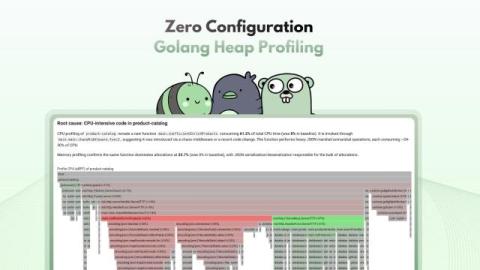
Zero-config Go heap profiling

Coroot's node-agent already collects CPU profiles for any process on the node using eBPF, with zero integration from the application side. For Java, we dynamically inject async-profiler into the JVM to get memory and lock profiles. But Go processes were still a blind spot for non-CPU profiling unless the app exposed a pprof endpoint and the cluster-agent scraped it. We wanted the same zero-config experience for Go heap profiles. This post is about how we got there.

Argo Rollouts Canary Monitoring: Metrics, Gotchas, and Automated Gates with Last9

Argo Rollouts exposes Prometheus metrics on port 8090 — but the docs lie about which labels exist. Here's how to scrape them into Last9, build a canary dashboard, and use Last9 as an automated AnalysisTemplate gate, including the auth and base64 gotchas. Prathamesh works as an evangelist at Last9, runs SRE stories - where SRE and DevOps folks share their stories, and maintains o11y.wiki - a glossary of all terms related to observability.

Customize preconfigured views for AWS, Azure, and Google Cloud with Cloud Provider Observability in Grafana Cloud

Part of what makes Cloud Provider Observability in Grafana Cloud really useful is that it gives you prebuilt dashboards and drill-downs for AWS, Azure, and Google Cloud. Out of the box you get service overviews, instance-level views, and quick links to explore your data. However, you might already have dashboards you trust, want a view tailored to your team’s workflow, or need to change which panels show up when you drill into a single instance.

Approaching the Parhelion

One early spring morning in 1535, the residents of Stockholm awoke to a most curious sight. Six suns lit up the sky, connected by bright halos, as immortalized in Vädersolstavlan, seen here. Today, we recognize these atmospheric effects as a parhelion (also referred to as ‘sun dogs’)—an illusion caused by light refracting off crystalline formations in the atmosphere.