Operations | Monitoring | ITSM | DevOps | Cloud

Master your website speed with these free tools

Speed matters! At least as far as getting the right information at the right time is concerned. When surfing the Internet, one of the most noticeable aspects about a website is its loading speed. After typing in a URL or clicking on a link, everyone expects to be directed to their desired website in under a second, or if not, in at most 2 seconds. And any website that takes more than that to serve information starts getting on a user’s nerves.


Improving web performance with browser hints & preload

When it comes to making the Internet a better experience for all, you need to take advantage of every opportunity to enhance website performance. In this article, we look at browser hints like prefetch and prerender along with the newer preload directive to see how they can potentially improve performance. We also take into consideration what that means for synthetic and real browser monitoring.

Why Are Less Than 1% Of Critical Alerts Investigated?

Many organizations seem to be suffering from alert fatigue. In a recent EMA report, according to Infosecurity, 80% of organizations that receive 500 or more severe/critical alerts per day, happen to investigate less than 1% of them. A shocking number to say the least! But what are the obstacles organizations are facing that allows such neglect?

Top 10 Java Performance Problems and How to Solve Them

Java is one of the most popular technologies for application development. Tens of thousands of enterprise applications are powered by Java and millions of people use them daily. Java has been evolving over many decades and there are so many web frameworks, middleware, data access technologies and protocols built on Java.

Your Rails & Elixir performance metrics inside Chrome Dev Tools

Browser development tools - like Chrome Dev Tools - are vital for debugging client-side performance issues. However, server-side performance metrics have been outside the browser's reach. That changes with the Server Timing API. Supported by Chrome 65+, Firefox 59+, and more browsers, the Server Timing API defines a spec that enables a server to communicate performance metrics about the request-response cycle to the user agent.

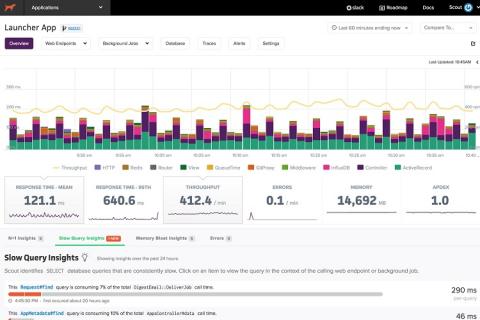
Under-the-hood with Scout: a look at a New Relic alternative

When New Relic launched ten years ago, web applications had a tendency to fail hard and in more obvious ways. Today, it's easier to build resilient apps, but they fail in more complex, unique, and subtle ways. These issues are time-consuming to track down. While several niche New Relic alternatives have appeared, they've focused on a lighter feature set versus solving these increasingly hard performance problems.