Operations | Monitoring | ITSM | DevOps | Cloud

How to Trial Honeycomb and OpenTelemetry

Insightful proof-of-concepts with a tool can be difficult to undertake due to the demands on valuable resources: time, energy, and people. With a task as grand as observability, how could one truly test if Honeycomb and OpenTelemetry are right for their organization and meet their requirements? For this thought experiment, here’s a comprehensive description of the ideal product evaluation over the course of four weeks, given unlimited resources.

Should I Stay or Should I Go? Get smarter about your refresh cycles

Deciding what to migrate, what to modernize, and what to retain on-premises is part of enterprise IT infrastructure management. When a refresh cycle is up in your data center, there are two very different types of competing motions you need to evaluate. While they may appear to be independent, they’re also kind of not, so it can be tricky to decide which one to execute—or even to execute both—and to do so smoothly.

Expand Your Monitoring Capabilities with AppSignal's Standalone Agent Docker Image

Want to monitor all of your application's services? Our Standalone Agent allows you to monitor processes our standard integrations don't monitor by default, helping you effortlessly expand your monitoring capabilities. To help simplify the process of configuring our standalone agent, we're excited to announce the launch of our Standalone Agent's Docker image, available on Docker Hub under the name appsignal/agent.

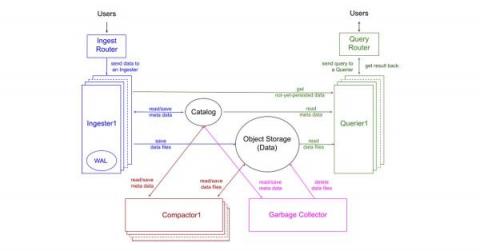
InfluxDB 3.0: System Architecture

InfluxDB 3.0 (previously known as InfluxDB IOx) is a (cloud) scalable database that offers high performance for both data loading and querying, and focuses on time series use cases. This article describes the system architecture of the database. Figure 1 shows the architecture of InfluxDB 3.0 that includes four major components and two main storages.

Exploring the Benefits and Trade-Offs of Microservices and Serverless Architectures

Just how in demand is serverless computing, really? Popularized by Amazon in 2014, serverless computing had already clinched the title of the highest-growth public cloud service as early as 2018. With its total market value shooting past the USD 9 billion mark in 2022 and projected to hit a jaw-dropping USD 90 billion by 2032, it’s safe to say this relative newcomer is doing quite alright for itself.

AWS ECS pricing optimization: Maximizing cost efficiency with CloudSpend

Amazon Elastic Container Service (ECS) is an extremely scalable and high-performing container orchestration solution that allows for the effortless execution, termination, and administration of Docker containers within a cluster. As more organizations embrace containerization, optimizing the costs of running containerized applications is essential, especially when using managed services like Amazon ECS.

The Ultimate Beginner's Guide to AIOps

The traditional approach to operations management is quickly growing extinct in organizations, given the replacement of siloed architectures by integrated systems that can work with the multi-cloud, microservices, Kubernetes and distributed architectures of the modern enterprise. While modernization of IT operations was already in full swing, the pandemic tipped it over. Through the pandemic, IT operations teams were on their toes and continue to be as organizations adopt hybrid work approaches.

Transformations in network technology

Over the past five years, enterprise networking has undergone a significant transformation driven by advancements in technology, the rise of cloud and SaaS applications, the decentralization of the workforce, and the need for agility, scalability, and cost mitigation. These factors have led organizations to shift from on-premise network management systems (NMS) to cloud-managed networking platforms and to adopt technologies like Software-Defined Wide Area Networking (SD-WAN).

AI-Augmented Software Engineering

While Artificial intelligence (AI) has invaded many industries, the IT industry is reaping the benefits of AI in software engineering practices. The traditional method of relying solely on human coders throughout the entire development lifecycle is gradually becoming obsolete. Instead, AI-augmented software engineering has come into the arena to make the software engineering process faster, easier, and more reliable.