Operations | Monitoring | ITSM | DevOps | Cloud

3 models for logging with OpenTelemetry and Elastic

Arguably, OpenTelemetry exists to (greatly) increase usage of tracing and metrics among developers. That said, logging will continue to play a critical role in providing flexible, application-specific, event-driven data. Further, OpenTelemetry has the potential to bring added value to existing application logging flows.

NetOps in Action: Fidelity National Information Services, Inc. (FIS)

Fidelity National Information Services, Inc. (FIS) is an American multinational corporation which offers a wide range of financial products and services. FIS is most known for its development of Financial Technology, or FinTech. FIS has a portfolio of products for the financial services sector, including both retail and investment banking. FIS global customers connect to services from FIS’s Little Rock, AR datacenter.

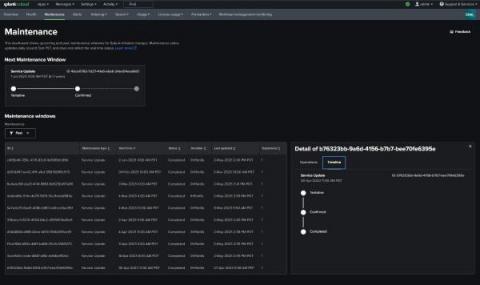
Announcing the General Availability of Cloud Monitoring Console's Maintenance Dashboard

Calling all Splunk Cloud Platform admins! At Splunk, we're dedicated to making your lives easier when it comes to managing various aspects of your Splunk Cloud Platform. One critical aspect that requires your attention is maintenance, which directly impacts the operational efficiency of your deployments. As the capabilities of the Splunk Cloud Platform grow, so do the Splunk-initiated updates like upgrades to keep your deployments up-to-date with the latest features and functionality.

The Goal With Every Release: Stay Laser Focused on Driving Value for Customers

As our customers share their frustrations with the volume and growth of their observability data, we’ve got our eyes set on making it easier to manage. Our Spring 4.1 Launch involved enhancements to the Cribl suite of products — Cribl Stream, Cribl Edge, and Cribl Search — that give users more choice and control over their end-to-end observability architecture.

Code Refactoring and why you should refactor your code

Software does not expire, but it “rots”. Its quality degrades over time. As you build your project and add features, you probably won’t always build it in a clean, orderly and mindful way. Especially if you have a tight deadline. So aside from features, you also produce bugs, code smells, and technical debt. That “rots” your software, but your job as a software engineer is to maintain its “freshness” while building on top of it.

Monitoring with Graphite: Architecture and Concepts

In this article, we provide a concise guide to help you get started with Graphite quickly and efficiently. We cover the basic concepts, architectural considerations, and metrics aggregation of Graphite. We also explain the data feeding methods, metrics format, and storage using Graphite's file-based database. Additionally, we discuss visualization options, including Graphite-Web and Grafana.

The lowdown on Loki for log aggregation: 5 demos you don't want to miss

Looking to get started with log aggregation? Or perhaps take your logging game to a whole new, more advanced level? You’ve come to the right place. Grafana Loki is a key component of Grafana Labs’ open and composable Grafana LGTM stack (Loki for logs, Grafana for visualization, Tempo for traces, Mimir for metrics).

Grafana k6 v0.45.0 release: gRPC streaming support, cloud script updates without running tests and more!

Grafana k6 v0.45.0 has been released, featuring a new experimental module for gRPC streaming support, a new browser recorder extension for Firefox and Chrome, and tons of improvements for Grafana k6 OSS and Grafana Cloud k6. Here’s a quick overview of the latest k6 release and all the news from the community.

Azure Incident Management with Escalation Policy

These days, businesses heavily rely on cloud services like Microsoft Azure to power their operations. While Azure provides robust infrastructure and services, occasional issues and incidents can still occur. Serverless360 provides enhanced capabilities to monitor and manage Azure incidents in a system. But to ensure seamless operations and timely resolution of problems, it is crucial to have a well-defined escalation policy in place for Azure Incident Management..

The Curious Case Of Kubernetes Health Checks

Health checks for cloud infrastructure refer to the mechanisms and processes used to monitor the health and availability of the components within a cloud-based system. These checks are essential for ensuring that the infrastructure is functioning correctly and that any issues or failures are detected and addressed promptly. Health checks typically involve monitoring various parameters such as system resources, network connectivity, and application-specific metrics.