Operations | Monitoring | ITSM | DevOps | Cloud

Get smarter about M&A IT infrastructure integration

That’s great news—your business is growing, and opportunities abound. It also means you will have to align the acquired company’s IT infrastructure with your own. What this looks like will vary depending on the specifics of any given merger. In some cases, where the acquired entity will continue to operate independently, you may simply look for opportunities to optimize and create economies of scale.

Thin Clients and their Role in End User Computing (EUC)

A thin client is a simplified device that relies on a separate server (usually located remotely or in the cloud) to run programs and complete user tasks. It connects to the server through a remote network connection with very little computing happening on an individual user’s device. Because most of the computation occurs and data is stored on the server, thin clients are regarded as a secure efficient option.

Turning Up the Heat: Cribl's Summer Product Launch

Hey there, Cribl fans! We hope you’re ready to move into the second half of summer with a splash because we have some exciting news to share. Our latest product launch is all about enabling teams and multiple users to work together seamlessly while focusing on security, access control, and providing valuable data insights on demand. Who says you can’t have it all? Let’s dive right into the details!

Troubleshooting Microsoft Teams Performance Issues

When it comes to the relative merits of hybrid work approaches, there can be a range of opinions; some are strong advocates, some see significant downsides, and many fall somewhere in between. About the one thing pretty much everyone can agree upon is that the rise in hybrid work has made the jobs of IT operations teams much more challenging. On any given day, a user may be working in the office, from their home kitchen, a neighborhood café, or just about anywhere else.

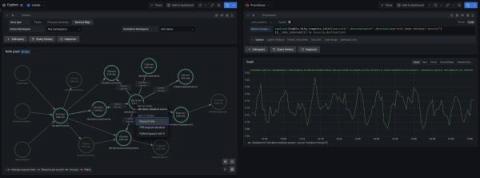
How to monitor Kubernetes network and security events with Hubble and Grafana

Anna Kapuścińska is a Software Engineer at Isovalent, who has a rich experience wearing both developer and SRE hats across the industry. Now she works on Isovalent observability products such as Hubble, Tetragon, and Timescape, as well as the respective Grafana integrations for all of them.

Logs vs Metrics: What Are They and How to Benefit From Them

In a rapidly evolving realm of IT, organizations are constantly seeking peak performance and dependability, leading them to rely on a reliable observability platform to obtain valuable system insights. Logs vs metrics play a vital role, as any full-stack observability guide would tell you, serving as essential elements for efficient system monitoring and troubleshooting. But what are logs and metrics, exactly?

Introducing Trace Endpoint Mapping

At Lumigo, we see ourselves as your reliable ally in the noble mission of detecting and vanquishing troublesome issues that lurk within your serverless and container applications. Our secret sauce? Equipping you with a wealth of detailed trace data, ensuring you’re always well-lit and ready for battle when the nefarious ‘bugs’ make their unsolicited appearances.

Observing Core Web Vitals with OpenTelemetry

Core Web Vitals (CWV) are Google's preferred metrics for measuring the quality of the user experience for browser web apps. Currently, Core Web Vitals measure loading performance, interactivity, and visual stability. These are the main indicators of what a user’s experience will be while using a web page.

Unify Infrastructure and Application Observability with Logz.io's Service Overview

Logz.io is excited to announce Service Overview, a fast and easy way to unify telemetry data and insights across your infrastructure and applications into a single interface. Our Beta users have reported simplified observability, faster time-to-insights, and observability consolidation.