Operations | Monitoring | ITSM | DevOps | Cloud

IPL: How to use the ipl-web TermInput

Most form fields ask users for a single value like a name, an email, or a date. But some need a list of values. A plain text input with comma-separated values can technically do the job, but it gives no feedback while typing, no suggestions, and one invalid entry rejects the whole field. The ipl-web TermInput solves this problem. Each value becomes a separate term with its own validation; terms can be enriched, and the input even supports suggestions.

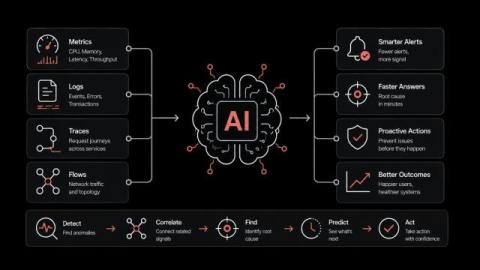
AI SRE Agent: How Autonomous Incident Investigation Is Eliminating Manual Root Cause Analysis

A critical production alert wakes you up: p99 latency just hit 4 seconds. You drag yourself to a terminal, open five dashboards, start correlating log timestamps with trace IDs, dig through 47,000 log lines across eight services, and 90 minutes later, you finally find the culprit: an N+1 database query introduced in a deployment that shipped four minutes before the spike started. An Atatus AI SRE Agent would have identified that root cause and drafted a remediation plan in 28 seconds. Not approximation.

What is AI-Powered Observability? A Complete Guide for IT Teams in 2026

Is your monitoring stack really giving you clarity, or just more alerts? Your monitoring stack is probably working exactly as designed. That is the problem. As systems grow, most IT and platform teams start to see the same patterns: At this point, traditional monitoring starts to feel limited. This is where teams begin exploring AI in observability. In this guide, we will explain what AI-powered observability actually means, how it works, and when it is useful.

Why Clean Dashboards Improve Reporting and Decision-Making

Reporting affects how leaders judge performance, catch strain points, and set priorities. Yet many teams still work from crowded views, disconnected files, and stale exports. That arrangement slows review, invites doubt, and weakens confidence in every figure shown on screen. Clean dashboards correct that problem by presenting important measures in a clear order, limiting visual clutter, and making changes easier to spot. Better reporting, in turn, supports steadier choices across finance, sales, operations, and service.

Web Accessibility Monitoring: an Ops Team Guide

Web accessibility monitoring is the automated, scheduled scanning of a website for accessibility failures. Unlike a point-in-time audit, monitoring runs continuously. Code changes, content updates, and third-party scripts all introduce regressions. Monitoring catches them before they become complaints. This guide covers how it works, and where it fits in an ops stack.

Introducing Microsoft DHCP management in OpUtils: From monitoring to full control

If you manage enterprise networks, this scenario probably sounds familiar: An IP conflict surfaces, connectivity drops for a group of users, and the confusion begins. You check your DHCP server, dig through scope utilization, and try to piece together what went wrong, often after the disruption has already occurred. For years, network administrators have needed a single console for visibility and control into DHCP.

New Explore: Faster answers, less friction, and a better way to investigate your data

There is a moment every engineer knows too well. Something is wrong in production. You have an alert, a vague symptom, and pressure to find the one signal that explains what changed. You open your logs and traces, and you immediately hit the same two problems: the dataset is huge, and the path from “I see something odd” to “I understand why” is full of tiny, exhausting steps. Meet new Explore, our redesigned investigation experience for logs, traces, and spans.

We Built a Better DNS Propagation Checker. Here's What Makes It Different.

Today we are launching the DNS Spy DNS Propagation Checker. It is free. It works on any domain. It shows you what is happening in more places, in more detail, and faster than the tools you have been using. You can try it right now: dnsspy.io/dns-tools/dns-propagation-checker.

Explore for Spans: One View with Infinite Depth

It’s 20 minutes into a P0 incident, and you have already switched between four different tools, re-authenticated twice, and translated queries across three incompatible syntax languages. The root cause you are searching for. Well, that is still out there somewhere. The reality of investigative latency is that most engineering teams face navigation problems, not data problems. During high-pressure incidents, teams lose cognitive momentum due to context switching between disconnected telemetry silos.

Building a Defensible AI Compliance Framework

Organizations have moved past theoretical conversations about AI adoption. Models, agents, and autonomous workflows are entering production environments. Business leaders are optimistic about potential gains in efficiency, decision support, and operational scale. Yet beneath this momentum, compliance and risk teams feel a different pressure.